
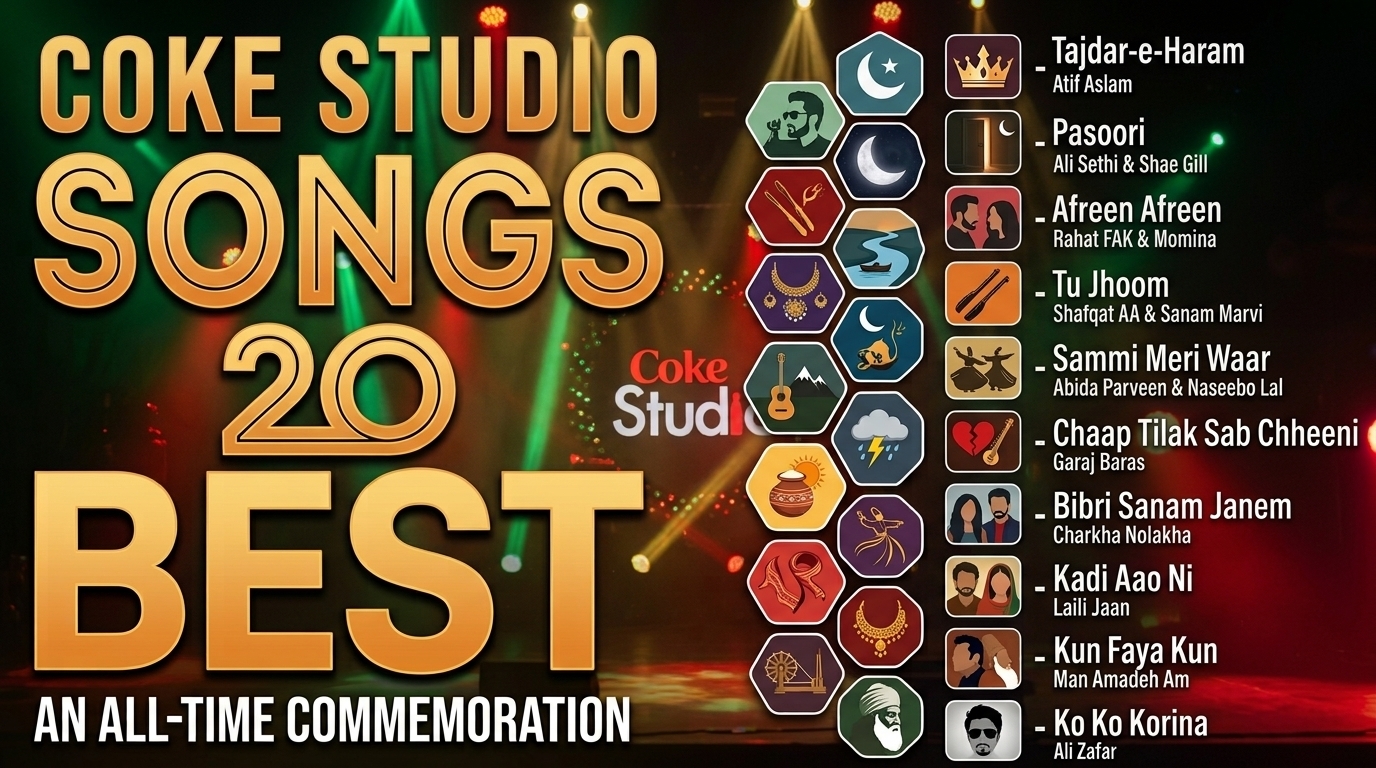
Few television formats have shaped a country’s musical identity the way Coke Studio Pakistan has shaped its own. Since its first episode aired in 2008, the show has taken folk poetry from Punjab, qawwali from Sufi shrines, classical ghazals and modern pop, and pressed them all into a single studio session, often with musicians who had never shared a stage before. Some of those sessions produced forgettable filler. Others produced songs that outgrew the show entirely and became part of the region’s everyday soundtrack, played at weddings, in taxis, and on repeat by a generation of listeners who never watched a single full episode.
Ranking the best Coke Studio songs of all time means wading through more than fifteen seasons, several changes in producer, and hundreds of tracks across Urdu, Punjabi, Pashto, Balochi, Sindhi and Persian. What follows is Weekly PK’s list of 20 songs that best capture why the show matters, drawn from its earliest years under Rohail Hyatt through the Strings era and into the Xulfi-led seasons that brought Coke Studio back to global attention.
1. Tajdar-e-Haram, Atif Aslam (Season 8)
Atif Aslam’s rendition of the Sabri Brothers’ qawwali classic remains, by most measures, the most-watched Coke Studio song ever produced. It turned a devotional piece into a career-defining moment for Atif and remains a staple at gatherings across Pakistan.
2. Pasoori, Ali Sethi & Shae Gill (Season 14)
The song that carried Coke Studio back onto the global stage. Blending Punjabi and Urdu with a beat built for both weddings and international playlists, “Pasoori” became the most-streamed Pakistani song worldwide the year it was released and introduced Shae Gill as one of the platform’s breakout voices.
3. Afreen Afreen, Rahat Fateh Ali Khan & Momina Mustehsan (Season 9)
A reinterpretation of Nusrat Fateh Ali Khan’s original, this version paired Rahat’s classical training with Momina Mustehsan’s softer, contemporary delivery. It became one of the most-viewed Coke Studio songs on YouTube and introduced Momina to a national audience overnight.
4. Alif Allah, Arif Lohar & Meesha Shafi (Season 3)
Built on a traditional Punjabi Sufi poem, this track paired Arif Lohar’s boisterous folk energy with Meesha Shafi’s vocals over dhol and chimta. It is still considered one of the definitive Coke Studio folk-fusion performances.
5. Paar Chanaa De, Shafqat Amanat Ali & Sanam Marvi (Season 5)
A Punjabi folk piece stripped down to its emotional core, this collaboration is frequently cited as one of the most raw, unpolished vocal performances in the show’s history, with Sanam Marvi’s delivery carrying much of its weight.
6. Tu Jhoom, Abida Parveen & Naseebo Lal (Season 14)
Opening Season 14, this Punjabi track paired two of Pakistan’s most distinct vocal styles, Abida Parveen’s Sufi command and Naseebo Lal’s folk grit, into a single, propulsive opener that set the tone for the show’s most commercially successful season.
7. Ranjish Hi Sahi, Ali Sethi
Ali Sethi’s tribute to Mehdi Hassan’s ghazal classic is widely regarded as one of his finest Coke Studio performances, restrained where the original demands restraint and personal without losing the song’s classical roots.
8. Sammi Meri Waar, Quratulain Balouch (Season 6)
QB’s rendition of this Punjabi folk standard became one of her signature Coke Studio moments, built around a hypnotic, repetitive melody that made it an instant favourite for live performance and covers alike.
9. Sar Kiye Ye Pahar, Strings (Season 1)
One of the earliest songs to prove the Coke Studio format could work, this Strings original, first released years before the show began, found new life in Season 1’s stripped-back arrangement and remains a touchstone for the platform’s founding years.
10. Garaj Baras, Ali Azmat & Rahat Fateh Ali Khan (Season 1)
Originally recorded for a Bollywood film promotion, the song only became a genuine hit once Rahat Fateh Ali Khan’s sargam was added for its Coke Studio version, turning it into one of Season 1’s defining tracks.
11. Kana Yaari, Kaifi Khalil, Eva B & Abdul Wahab Bugti (Season 14)
A Balochi-language track built around a simple, aching melody, “Kana Yaari” helped introduce Kaifi Khalil to a mainstream audience and became one of the breakout regional-language hits of the Xulfi era.
12. Jhol, Annural Khalid & Maanu (Season 15)
A minimalist, atmospheric track that leaned on mood over spectacle, “Jhol” became one of Season 15’s most streamed songs and reflected Coke Studio’s continued shift toward younger, independent artists.
13. Chaap Tilak Sab Chheeni, Abida Parveen & Rahat Fateh Ali Khan
Two of Pakistan’s most respected classical and Sufi vocalists sharing a single recording made this pairing an event in itself. The Amir Khusrau composition, performed with restraint by both singers, remains one of the show’s most-cited “serious music” moments.
14. Bibi Sanam Janem, Zeb & Haniya
An Afghan folk song reimagined by Zeb Bangash and Haniya Aslam, built around a rubab line and Pashto lyrics. Its unusual bass groove and unfamiliar-to-most-listeners language did nothing to slow its spread; it remains one of the duo’s most recognisable recordings.
15. Charkha Nolakha, Atif Aslam & Qayaas (Season 5)
A tribute layered with references to Nusrat Fateh Ali Khan and built on Qayaas’s arrangement sensibility, this track is often held up as one of the best-arranged songs in the show’s catalogue, and a reminder of what was lost when the band split.
16. Kadi Aao Ni, Mai Dhai & Atif Aslam (Season 8)
Mai Dhai’s commanding folk voice paired with a more restrained Atif Aslam than fans were used to hearing, this song is a favourite among listeners who prefer the show’s folk collaborations over its pop-forward tracks.
17. Laili Jaan, Zeb & Haniya (Season 6)
A Dari-language hit originally performed by Ahmad Zahir, reworked by Zeb and Haniya into one of their most fluid, boundary-crossing Coke Studio performances.
18. Kun Faya Kun, A. R. Rahman, Javed Ali & Mohit Chauhan (Coke Studio India)
Originally composed for the Bollywood film Rockstar, this devotional track found a second life in its Coke Studio India session, with A. R. Rahman’s presence as both producer and performer giving the recording added weight.
19. Man Amadeh Am, Abida Parveen & Rahat Fateh Ali Khan
A Persian-language devotional piece that leaned entirely on the two singers’ vocal command, with almost no reliance on modern production, proving that Coke Studio’s most powerful moments were sometimes its simplest.
20. Ko Ko Korina, Ali Zafar
A tribute to Ahmed Rushdi’s 1966 original, widely regarded as Pakistan’s first pop song, Ali Zafar’s version bridged generations of Pakistani pop and remains one of the show’s most affectionate homages to its own musical history.
Runners-up
A list of twenty inevitably leaves out songs that deserve mention. “Malang,” “Aaqa” by Kaifi Khalil, “Sajni,” “Ni Main Sammi,” “Rang De Basanti” from Coke Studio India, and “Mahi Sona” from Coke Studio Bangla have all built loyal followings of their own. So has “Aayi Aayi,” the Sindhi-language opener of Season 15, and “Kuch Hai” by Mizraab, a Season 4 track still cited by guitar players as one of the show’s most technically impressive recordings. Coke Studio’s catalogue is large enough that almost any list like this one will draw an argument, and that is, in a sense, the point.
Looking across these twenty songs, a pattern emerges. The tracks that have aged best are rarely the most produced or the most promoted; they are the ones where a single voice, or two voices in conversation, were given room to carry the arrangement. Whether that is Rahat Fateh Ali Khan restrained to a whisper on “Man Amadeh Am” or Ali Sethi and Shae Gill trading lines on “Pasoori,” the show’s biggest hits tend to share the same quality: a performance strong enough that the studio setting almost disappears.
That quality is also why Coke Studio has managed to stay relevant across four producers and more than fifteen years, from Rohail Hyatt’s founding vision through the Strings-led seasons to Xulfi’s current run. Each era brought a different sound, but the underlying idea, put serious musicians in a room and let the recording happen live, has not changed. It is why songs recorded a decade and a half apart can sit comfortably on the same playlist, and why a new listener discovering “Tajdar-e-Haram” for the first time in 2026 is likely to feel the same pull that audiences did in 2015.
“Tajdar-e-Haram” by Atif Aslam and “Pasoori” by Ali Sethi and Shae Gill are the two most commonly cited as the platform’s biggest hits, based on streaming numbers and cultural reach.
The show was founded and originally produced by Rohail Hyatt, who led it for its first several seasons. Strings’ Bilal Maqsood and Faisal Kapadia later took over production, followed by Zulfiqar Jabbar Khan, known as Xulfi, who has produced the most recent seasons.
The show has aired more than fifteen seasons since its 2008 debut, alongside spin-off editions including Coke Studio India, Coke Studio Bangla and other regional versions.
Both. The show is known for reworking traditional folk, Sufi and classical pieces with contemporary arrangements, but many of its biggest hits, including “Pasoori” and “Jhol,” are original compositions written specifically for the platform.
Coke Studio Pakistan has featured songs in Urdu, Punjabi, Pashto, Balochi, Sindhi, Persian and Saraiki, among others, reflecting the show’s stated aim of showcasing the country’s full linguistic and musical diversity.
Yes. The platform continues to release new seasons and songs, and its various regional editions, including Coke Studio India and Coke Studio Bangla, remain active as well.
Leave a Reply