
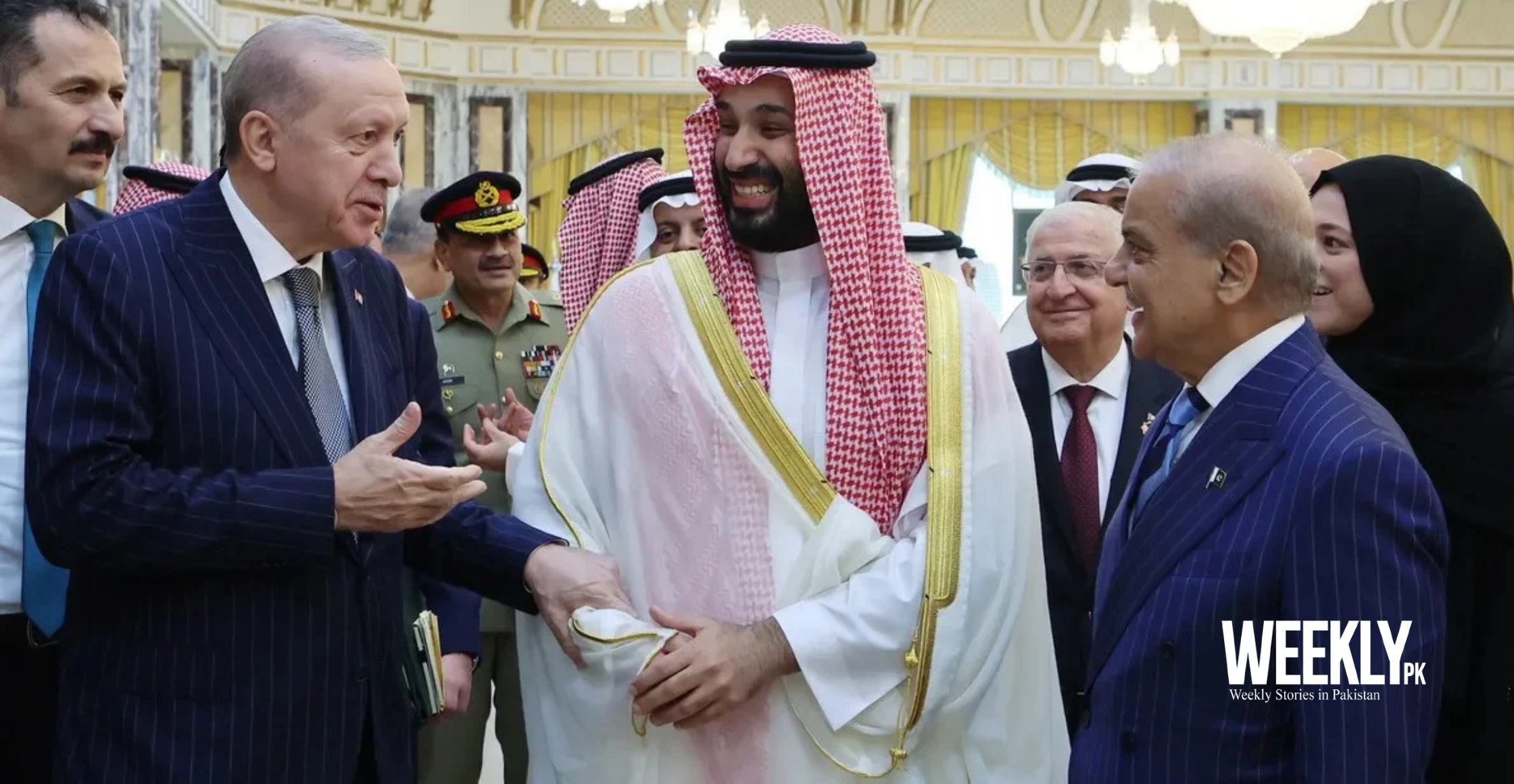
Pakistan’s military spokesman has said the collective deterrence mechanism of the Makkah defence pact is already in effect and that Islamabad is giving Saudi Arabia the support it needs to defend itself against Houthi attacks. The remarks, made in an interview with Independent Arabia and widely reported in Pakistani media in recent days, are among the clearest public statements yet on how far Pakistan is prepared to go under the agreement it signed this year.
Director General Inter-Services Public Relations Lieutenant General Ahmed Sharif Chaudhry said Pakistan’s commitment to the arrangement is unequivocal and that Saudi Arabia’s sovereignty, territorial integrity and the security of the holy sites in Makkah and Madinah are non-negotiable. He said Pakistan has been sending strong signals, through its forces, official statements and operational employment, that the deterrence mechanism has already been actualised, and that the message is meant for everyone, whether they are in front or behind the Houthis. He added that any direct or indirect attack on a member of the alliance would trigger a collective response.
At the same time, he stressed that the alliance is defensive. When asked whether Pakistan’s support would remain defensive if the attacks continue, he said all three members were clear that the pact has no offensive intent and is purely defensive, according to Dawn. He also said Pakistan’s military cooperation with Saudi Arabia predates the alliance by decades and will continue. If a negotiated outcome cannot be reached and the situation turns into a military conflict, he said, the alliance’s instrument of collective deterrence will come into play, as he put it, as it is already coming into play.
The pact itself is a recent and significant commitment. Pakistan, Saudi Arabia and Turkey signed the Makkah Joint Defence Agreement on August 7 at a summit for joint defence in Makkah, and it treats an armed attack on one member as an attack on all. Dawn reported that the parties may not withdraw from the agreement for the first 10 years. Pakistan has already ratified the treaty, and under its executive-led system only the approval of the prime minister and cabinet is required under Article 90 of the Constitution. Turkey, by contrast, has submitted the agreement to its parliament for ratification, and Turkish officials have indicated that Ankara’s support may be limited to the provision of weapons, equipment and intelligence sharing. Pakistan, Turkey and Saudi Arabia have also agreed on rapid force deployment in the kingdom under the pact, and ARY News linked to a separate report in which the DG ISPR confirmed the presence of Pakistani troops in Saudi Arabia under the agreement.
The statements come as the pact faces its first practical test. Houthi missile and drone attacks have hit Saudi Arabia in recent weeks, including strikes on Riyadh airport that killed more than a dozen people, and Pakistan, Turkey, Egypt and Saudi Arabia have jointly condemned the attacks. The DG ISPR said other states committed to regional peace could join the alliance, and confirmed reports that Egypt and Syria have expressed interest. Egypt’s parliament is due to vote on support for Riyadh on October 26.
Chaudhry also addressed the situation in Yemen directly. He said Pakistan would review any formal request for direct military assistance from Yemen’s internationally recognised government, a notable comment because it suggests that Islamabad is at least prepared to consider a role that goes beyond the territory of Saudi Arabia. He did not say that Pakistan would agree to such a request, and he emphasised that a negotiated outcome is the preferred path.
Several questions follow from these statements. The first is what exactly “already actualised” means in practice. Pakistan has said it is providing whatever support is needed, but it has not publicly specified what that includes, how many personnel are involved, or what rules govern their use. The second is where the line between defensive deterrence and active involvement lies, particularly if Houthi attacks continue or if a Yemeni request for assistance materialises. The pact describes itself as defensive, but the practical meaning of defence in a conflict that involves missile and drone attacks across borders is not simple.
The third is regional balance. Pakistan has been trying to keep channels open with Iran, which backs the Houthis, and its military leadership has recently met Iranian President Masoud Pezeshkian in a meeting that raised hopes of de-escalation, according to Dawn. Islamabad has also played a mediating role in earlier efforts to end the confrontation between the United States and Iran. The public message of firm support for Saudi Arabia, alongside continuing diplomacy with Tehran, will require careful management, and the more explicit Pakistan’s military commitments become, the harder that balance may be to hold.
There is also a domestic dimension. Pakistan is dealing with militancy along its western border and political tension at home, and large numbers of Pakistanis live and work in Saudi Arabia, which means that any escalation reaches families in Pakistan quickly. A Pakistani resident was among those killed in the recent attacks on Riyadh. Public understanding of what the pact commits the country to, and parliamentary scrutiny of that commitment, are likely to grow as the deployment becomes more visible.
For now, the military’s message is a mix of reassurance and warning: the alliance is defensive, it is already in effect, and a negotiated solution is preferred, but a failure of diplomacy would bring the full mechanism into play. How long that balance holds depends largely on what the Houthis do next and on whether talks can ease a conflict that is drawing in more countries each week.
Compiled by the Weekly PK National Security Desk.
Leave a Reply