
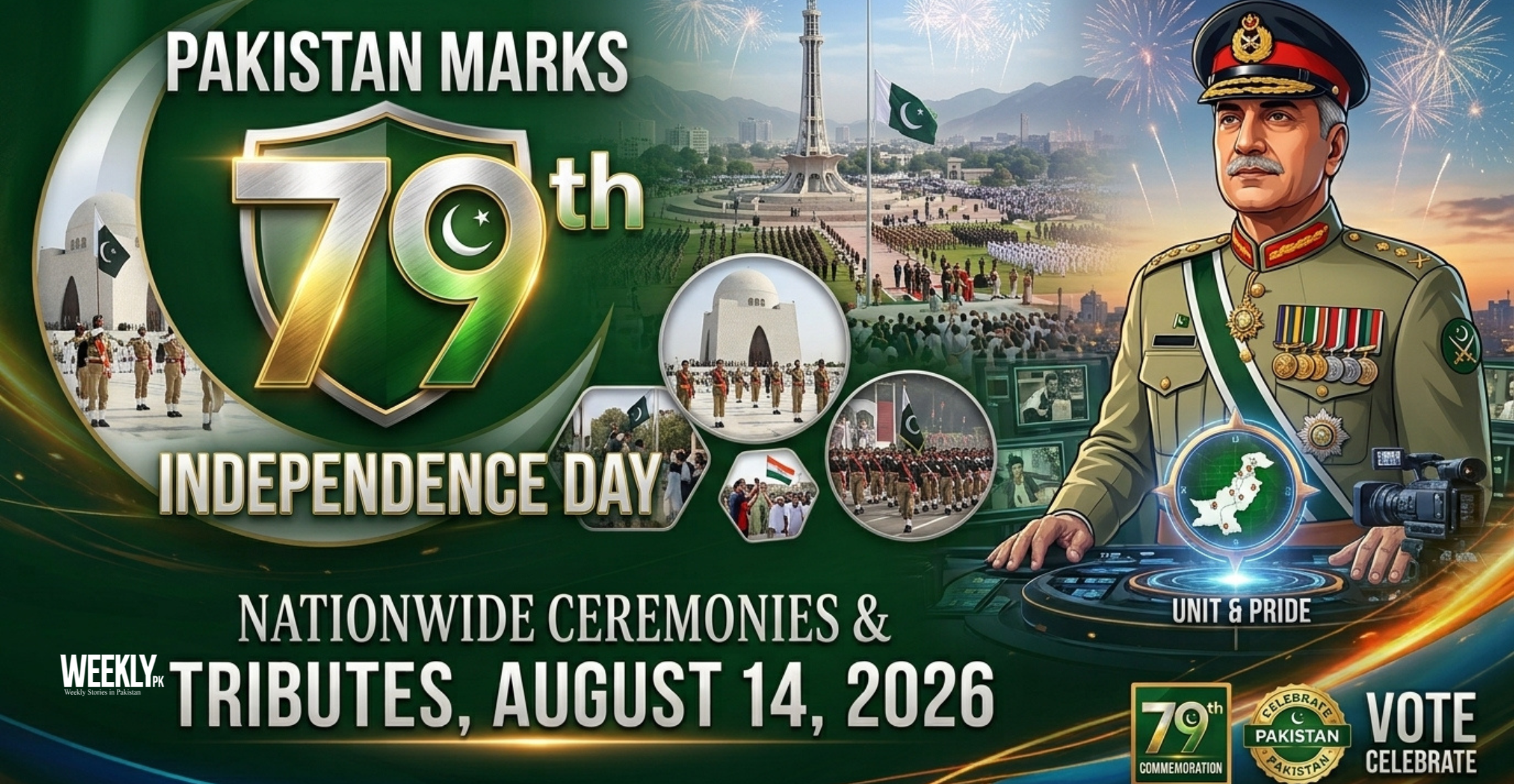
Pakistan is marking its 79th Independence Day on Friday, with flag-hoisting ceremonies, gun salutes and cultural programmes held across the country to commemorate the anniversary of the nation’s creation on August 14, 1947. The day began with a 31-gun salute in the federal capital and a 21-gun salute in the provincial capitals, with special prayers offered at mosques across the country for peace, solidarity and prosperity.
President Asif Ali Zardari hoisted the national flag at a special ceremony in Islamabad, with similar flag-hoisting ceremonies also held at provincial, divisional and district headquarters across the country. Buildings, streets, markets and public places have been decorated with national flags, buntings and colourful lights, giving towns and cities a festive look, and a wide range of programmes, including seminars, exhibitions and cultural events, have been organised to mark the occasion.
On the eve of the anniversary, President Zardari, Prime Minister Shehbaz Sharif, and Chief of Defence Forces and Chief of Army Staff Field Marshal Asim Munir jointly inaugurated the Yadgar-e-Fatah monument in Islamabad, which commemorates Pakistan’s victory over India during the May 2025 conflict. This year’s Independence Day celebrations are unfolding against that backdrop, with the country marking 79 years of independence alongside what officials have described as a renewed commitment to the ideals of the Pakistan Movement.
In his message on the anniversary, President Zardari paid tribute to Quaid-e-Azam Muhammad Ali Jinnah, the leaders and workers of the Pakistan Movement, and those who sacrificed their homes, security and livelihoods for the creation of Pakistan, and said independence is not merely a historic achievement but a responsibility that every generation must carry forward. Prime Minister Shehbaz Sharif, in his own remarks, said the country had achieved economic stability over the past two and a half years and was now working toward becoming a developed economy. On foreign policy, he noted that Pakistan has used its diplomatic channels, geographical position and diplomatic capital to promote dialogue and de-escalation amid rising tensions in the Middle East, adding that disputes, however serious, must ultimately be resolved through dialogue and diplomacy.
Karachi observed the day with its own set of traditional ceremonies. A change of guard ceremony was held at Mazar-e-Quaid, the mausoleum of the Founder of the Nation, in the city, continuing a practice that has marked the anniversary in the city for decades. Vendors across Karachi were seen in the days leading up to the anniversary selling flags, badges and other patriotic merchandise, a familiar sight in the run-up to August 14 in cities across the country.
To mark the occasion nationally, the Inter-Services Public Relations department released a new national song, “Mera Pyara Watan Pakistan,” whose lyrics reflect love for the motherland and national unity. Independence Day is also being observed with enthusiasm in Azad Jammu and Kashmir.
In Islamabad, the federal capital has hosted a packed slate of public events through the day. Several events were scheduled at prominent locations including the Parade Ground, Pakistan Monument, Lok Virsa and F-9 Park, giving residents multiple options to mark the occasion. Celebrations also featured a Pakistan Air Force flypast and fireworks at midnight, with the midnight programme centred around the Markaz-e-Haq Monument near the H-8 Expressway. A daytime PAF flypast was expected over the Parade Ground and the Expressway, while an event was also planned at F-9 Park, and the City Parade was scheduled for the old Parade Ground at 5pm.
Cultural programming rounded out the capital’s celebrations. Lok Virsa hosted a special Independence Day programme titled “Milli Naghmon Ki Shaam – Jashn-e-Azadi” at its Open Air Theatre from 6pm to 8pm, featuring an evening of national songs and patriotic performances with free entry for the public.
This year’s anniversary carries particular symbolic weight as Pakistan’s Diamond Jubilee-adjacent milestone approaches. The country is celebrating the 79th anniversary of its independence with flags, ceremonies, national anthems and tributes to those who fought for its creation. Pakistan gained independence at midnight at the end of August 14, 1947, ending nearly two centuries of British rule over the subcontinent. National Today
The road to that moment stretched back years before the actual transfer of power. The demand for a separate homeland for the Muslims of British India crystallised through the Pakistan Movement, led by the All-India Muslim League under Muhammad Ali Jinnah, revered nationally as Quaid-e-Azam, the Great Leader. A pivotal moment came in March 1940, when the Lahore Resolution, later known as the Pakistan Resolution, was passed at a gathering in Lahore’s Minto Park, calling for independent states in the Muslim-majority regions of north-western and eastern British India.
The scheduling of the actual independence ceremonies also has a specific history behind it. The last British viceroy, Lord Mountbatten, deliberately scheduled Pakistan’s independence ceremony a day before India’s transfer of power so that he could attend both events, travelling on to Delhi for the Indian ceremony at midnight on August 15. That arrangement is why the two neighbouring countries mark their independence on consecutive days. Notably, the night of August 14 to 15, 1947 also fell on the 27th of Ramadan in the Islamic calendar, a date Muslims regard as especially sacred, lending the moment additional spiritual significance for many Pakistanis. The birth of Pakistan was accompanied by one of the largest mass migrations in human history, as millions of people crossed the new borders in both directions.
The flag that is raised at ceremonies across the country each August 14 also carries its own history. It was officially adopted on August 11, 1947, a few days before independence was declared, the same day Muhammad Ali Jinnah was unanimously elected president of Pakistan’s first Constituent Assembly. The flag consists of a dark green field with a white vertical stripe near the hoist, and a white crescent and five-pointed star placed on the green field. The green represents the country’s Muslim majority, while the white stripe symbolises Pakistan’s religious minorities; the crescent is traditionally associated with progress, and the star with light and knowledge.
Beyond the official state ceremonies, the day is marked by public participation across the country. Celebrations typically involve flag-hoisting ceremonies, parades and the singing of the national anthem, with public buildings illuminated and citizens decorating their homes and vehicles. The president and prime minister deliver special speeches recalling the sacrifices of the nation’s forefathers, while district and local authorities plan events to add colour to the day and express patriotism. Schools and universities across the country typically arrange declamation contests, art exhibitions, national song recitals and sports events to mark the occasion.
The Pakistani diaspora has also joined in the commemorations from abroad. The day is observed nationwide across all four provinces, in Islamabad, and in the territories of Azad Jammu and Kashmir and Gilgit-Baltistan, and is also marked by large Pakistani communities in the United Kingdom, the United States, the Gulf states, Canada and elsewhere, often through cultural festivals, flag-raising events and community gatherings. Neckbands
For many Pakistanis, the anniversary remains as much a moment of family tradition as it is of official ceremony. Common ways of marking the day include attending a local flag-hoisting event, dressing in the national colours of green and white, and visiting historic sites such as the Minar-e-Pakistan in Lahore or the Mazar-e-Quaid in Karachi. National broadcasters have also aired special transmissions and documentaries through the day, a tradition that has held steady across successive anniversaries.
This year’s celebrations arrive at a moment when Pakistan’s leadership has framed the anniversary not only as a commemoration of 1947 but as a marker of the country’s more recent trajectory, including the events of the past year and the government’s stated economic priorities. As the flag was raised over Islamabad, Karachi and cities across the four provinces on Friday morning, the ceremonies carried the same core elements they have for decades: the national anthem, the gun salutes, the change of guard at the mausoleums of the country’s founding leaders, and a public that continues to turn out in green and white to mark the day Pakistan came into being.
Leave a Reply