
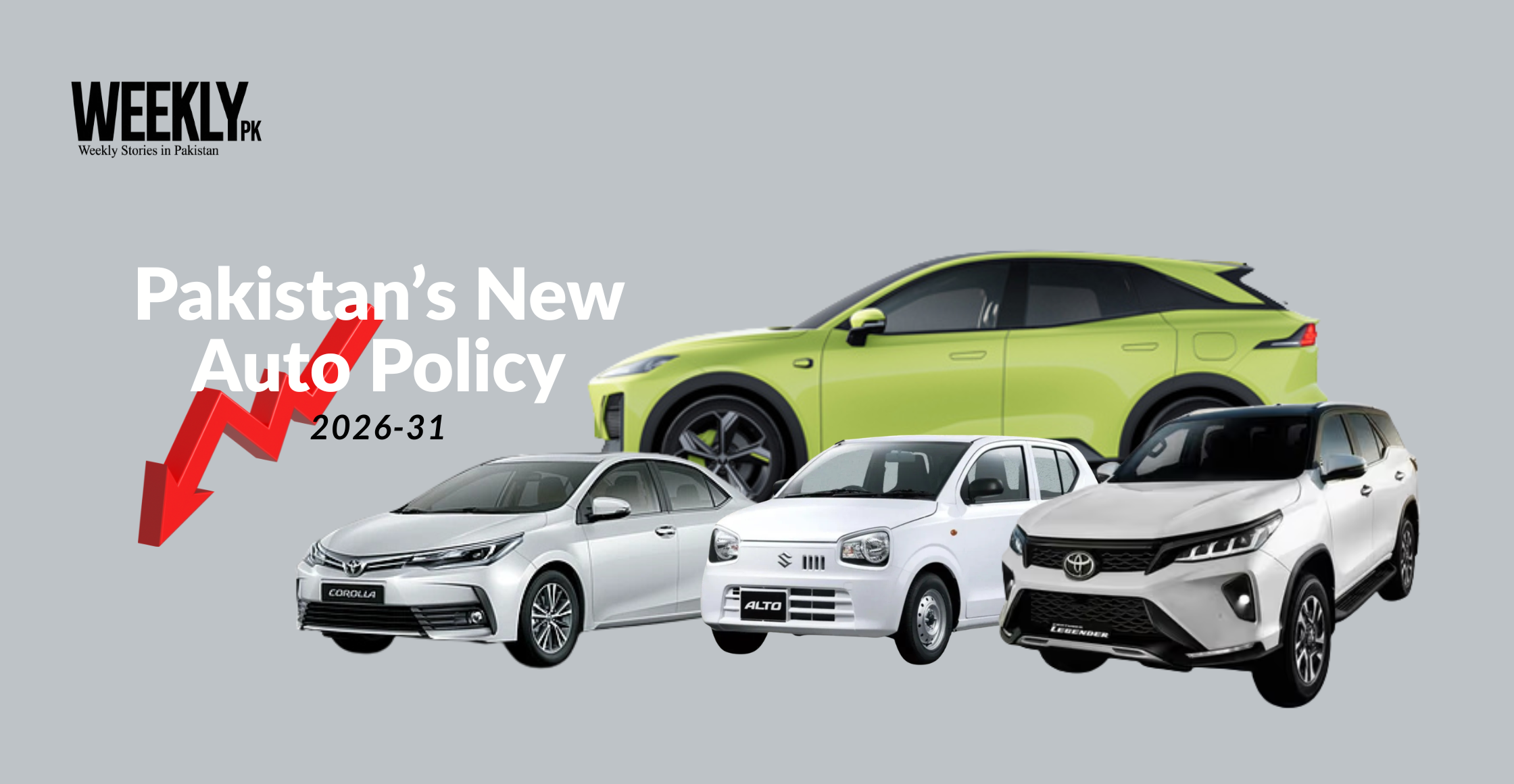
Pakistan’s proposed Auto Policy 2026-31 promises cheaper electric vehicles, a levy on larger petrol and diesel cars and a $6 billion export target, but it has not yet taken effect, and several parts of it still depend on approval from the federal cabinet and the International Monetary Fund. The policy was presented by ministers at a briefing on Saturday, and it has been the subject of debate since the Prime Minister first gave in-principle approval to an earlier draft in September.
The framework rests on six priorities, according to the briefing: affordable vehicles, automobile exports, localisation, safety, electric mobility and industry transparency. Its stated aims include raising vehicle exports to $6 billion over five years, cutting car prices step by step and speeding up the shift to electric vehicles, with a target of 30% of new vehicle sales being electric by 2030, a goal officials say could be reached sooner. The same target appears in the New Energy Vehicles Policy 2025-30, which the new policy is meant to work alongside.
The tax changes for electric vehicles are the headline. Fully electric cars would pay a sales tax of 1%, range-extended electric vehicles 6% and plug-in hybrids 9%, compared with the standard 18% on conventional vehicles. Electric vehicles priced up to $50,000 would be exempt from capital value tax, withholding tax and federal excise duty. Financing would also expand, with EV loans of up to Rs10 million over five years, and sales tax on charging equipment would fall to 1% with customs duty removed, according to Gulf News and NextUp News. A report on the earlier draft said the policy also targets 3,000 public charging stations by 2030.
To pay for these incentives, the government proposes an automotive development levy on conventional petrol and diesel vehicles above 1,000cc. Ministers said cars of 1,000cc and below would face no additional taxes, and Information Minister Attaullah Tarar stressed that nothing changes for ordinary petrol vehicles in that category, since many common citizens still drive them. An earlier version, reported by Geo News in September, described a Rs100.36 billion programme to subsidise vehicle electrification, funded through a levy of 1% to 3% on internal-combustion-engine vehicles. The levy’s final rate and design are not settled in the reports reviewed.
The policy also changes how imported and locally made vehicles are taxed. Under the draft reported in September, customs duties would be simplified into four tiers of 0%, 5%, 10% and 15%, cutting the weighted average import tariff from 15.7% to 5.99% by 2030, with duties on raw materials eliminated. Localisation targets would rise to 40% for passenger cars and 90% for bikes and rickshaws by fiscal 2030-31. Commercial imports of used vehicles up to five years old would be restricted to active corporate tax filers with sales, service and spare-parts networks, with an initial 40% regulatory tariff phased out by 2030. The policy would also enforce 62 UNECE safety standards and create an Auto Parts Export Council.
The most important caveat is its status. The policy replaces a framework that expired on June 30, 2026, and the Prime Minister gave in-principle approval in September. The ministerial briefing last Saturday marked the start of the federal cabinet process, and Geo reported earlier that IMF reviews were also part of the final approval. Reporting on the IMF’s position is mixed. One outlet said the Prime Minister approved the draft after securing the Fund’s concurrence, while another reported that the IMF had pushed back on lower sales tax for new energy vehicles, and a third said the EV tax rates were subject to IMF approval and that talks on the 1% rate were continuing. Until the cabinet clears the policy and the Ministry of Industries and Production notifies it, nothing in it changes the price of a car.
The question many buyers ask is whether cars will get cheaper. The answer, according to the proposals, is gradually and mainly for electric vehicles. Lower import duties are phased in through 2030, so price effects would build over time instead of arriving at once. Tax cuts on electric vehicles could narrow the gap with petrol models, particularly for buyers who can access the larger loans, while owners of petrol and diesel cars above 1,000cc could face the new levy. Reports also suggest the policy would end some existing hybrid sales tax concessions, though that is stated in a draft summary and has not been confirmed in the latest briefing.
Also Read: Pakistan’s Remittances Rise 13.8% to $3.9 Billion in October, Nearly Covering the Trade Deficit
There is evidence that the electric shift is already underway in two-wheelers. One analysis said electric two-wheeler sales grew from 60,000 in fiscal 2024-25 to 240,000 in 2025-26, and Prime Minister Shehbaz Sharif told the COP31 climate summit this week that more than 10% of motorcycles sold in Pakistan this year are electric. Cars are a different matter, with higher prices and a thin charging network, and the 3,000-station target would require rapid investment.
Commentary has been cautious. Dawn carried an opinion piece titled “Auto Policy 2026-31: ambition without scale?”, questioning whether the measures would reach enough buyers and manufacturers to change the industry. The concerns are those that any such policy faces: whether the levy raises enough to fund the incentives, whether local assemblers can meet localisation and export targets, and whether the power grid can handle more charging.
The next steps are clear. The cabinet will take up the policy, the IMF will weigh in on the tax rates, and the industries ministry will issue the final notification. Only then will manufacturers, importers and buyers know what rates apply. Until that happens, the policy is best read as a statement of direction: Pakistan wants more electric vehicles, fewer protected local assemblers and an export-oriented auto sector, and the question is how much of that survives the approval process.
Compiled by the Weekly PK Business Desk.
Leave a Reply