
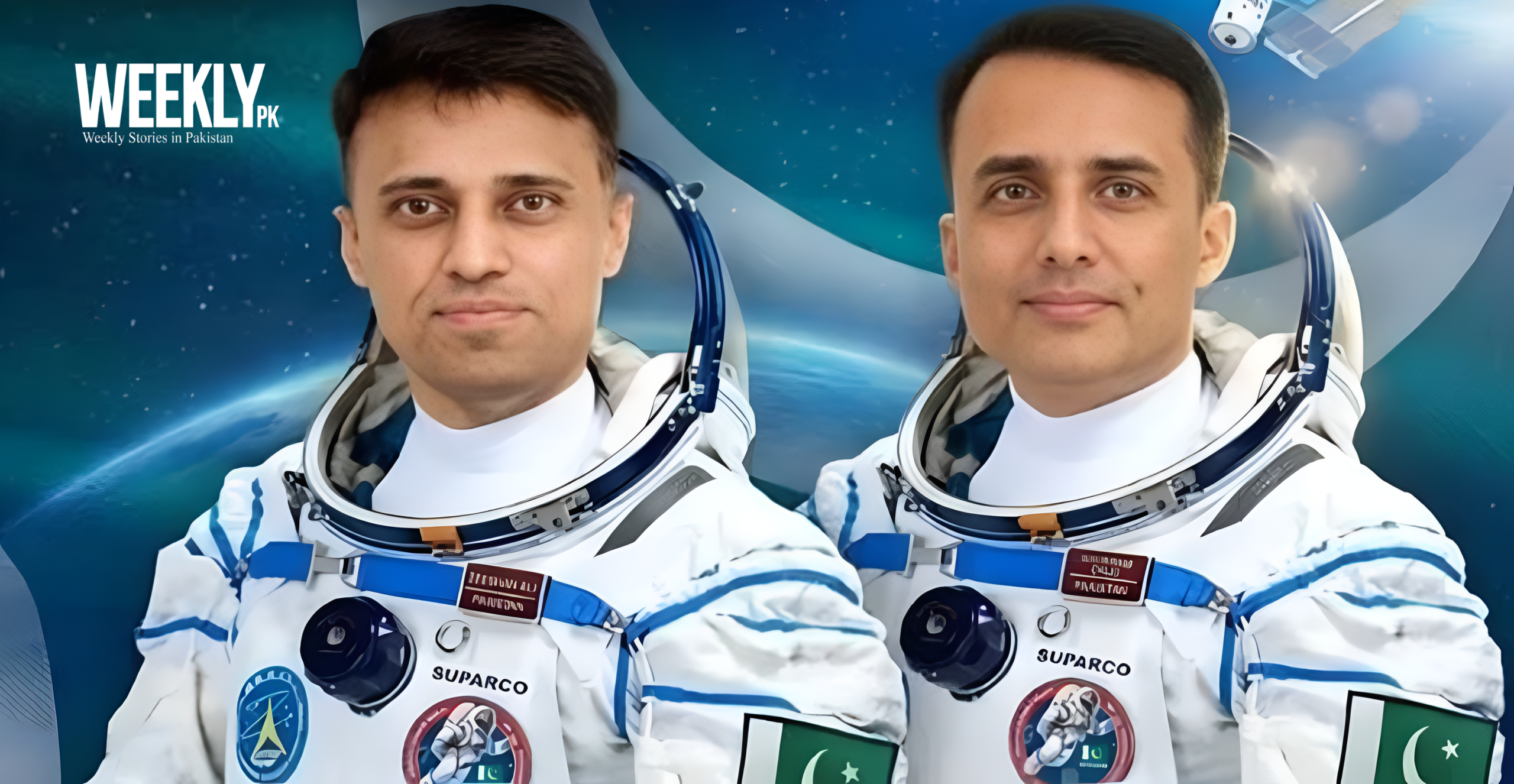
Pakistan is preparing to send its first astronaut into space on November 25, as a payload specialist aboard China’s Shenzhou-24 spacecraft to the Tiangong space station, in what will be the first visit by a foreign astronaut to the Chinese orbital outpost. The identity of the astronaut has not been announced, with two trained candidates still in the running.
The flight was confirmed by Planning Minister Ahsan Iqbal on October 18, who said the first Pakistani astronaut would embark on a space mission from China on November 25. A spokesperson for the Pakistan Space and Upper Atmosphere Research Commission (SUPARCO) said that of the two selected astronauts, one will serve as a payload specialist at the space station, according to The Express Tribune. The two candidates, Muhammad Zeeshan Ali and Khurram Dawood, whose surname is also spelled Daud, have both completed their training in China, and one will be chosen to represent the country. The China Manned Space Agency (CMSA) said in April that the two had been chosen to begin training, and it has not named the crew member who will fly, as Dawn reported.
According to the CMSA, the Pakistani astronaut will join a short orbital flight, staying about a week, and return aboard the Shenzhou-23 spacecraft that docked at Tiangong in May. The Shenzhou-23 mission is a landmark in itself: it carried Hong Kong’s first astronaut, Lai Ka-ying, who also flew as a payload specialist, and it is China’s first attempt at a year-long stay aboard the station, according to Wikipedia’s summary of the missions. That rotation pattern was designed to allow a short-duration visit by a foreign astronaut. A Chinese state media statement described Shenzhou-24 as China’s first manned space mission to include a foreign astronaut.
The partnership is built on an agreement signed in February 2025 between SUPARCO and CMSA, under which two Pakistanis would train in China, with one joining a mission to Tiangong. In a sign of how closely the programme has been tied to the relationship between the two countries, China unveiled the official logo of the Shenzhou-24 mission featuring jasmine, Pakistan’s national flower. And there is a cultural detail that adds a human dimension: both shortlisted astronauts previously studied Chinese at the Confucius Institute in Islamabad, according to Qu Zhaowei, Party Committee Secretary of Beijing Language and Culture University, who spoke to China News Service on November 13.
Also Read: South Korea’s Space Agency Releases Moon Images Following SpaceX Rocket Debris Impact
A payload specialist is not a professional astronaut in the traditional sense. The role typically involves carrying out experiments and research rather than operating the spacecraft or the station, and Tribune said the Pakistani astronaut is expected to conduct scientific research aboard the China Space Station. The reports reviewed do not say what experiments are planned, how many there will be, or which Pakistani institutions have contributed to them, and those details will matter for judging the scientific value of the flight.
Why does it matter? For Pakistan, the flight is a milestone in a national space effort that has historically relied on partners to launch its satellites. Sending a Pakistani citizen into orbit, even on a one-week mission, would give the country a presence in human spaceflight that it has not had before, and it will likely inspire interest in science and engineering among young people. For China, hosting a foreign astronaut on Tiangong shows the station as an international platform at a time when the International Space Station, the main alternative, is approaching the end of its planned life, and it fits a pattern of space diplomacy with partners such as Pakistan. A Dawn headline described it as China’s space diplomacy lifting a Pakistani astronaut toward orbit.
Also Read: Pakistan Flight-Tests Its First Indigenous Fa’az Air-to-Air Missile: What We Know and What We Don’t
The partnership also has limits worth noting. The flight is short, the role is as a payload specialist, and the programme depends on Chinese hardware, training and launch services. That is not unusual for first-time space nations, but it raises questions about what Pakistan will build on its own afterwards. A domestic astronaut programme, a research agenda for the experiments and a plan for future flights would show whether the mission is a one-off event or the start of a continuing effort, and the coverage reviewed does not describe such plans.
Several questions remain. Who will fly, and when will the decision be announced? What experiments will the astronaut carry out, and who will receive the data? Will there be a second Pakistani flight, or will the other candidate serve as a backup? And how will SUPARCO use the attention to strengthen its own programmes? The launch is scheduled for five days from now, and the answers to some of these should emerge soon.
For millions of Pakistanis, the immediate fascination will be simpler: for the first time, someone from their country is about to see Earth from orbit. How much that moment changes the country’s science and education will depend on what follows it.
Compiled by the Weekly PK Science Desk.
Leave a Reply