
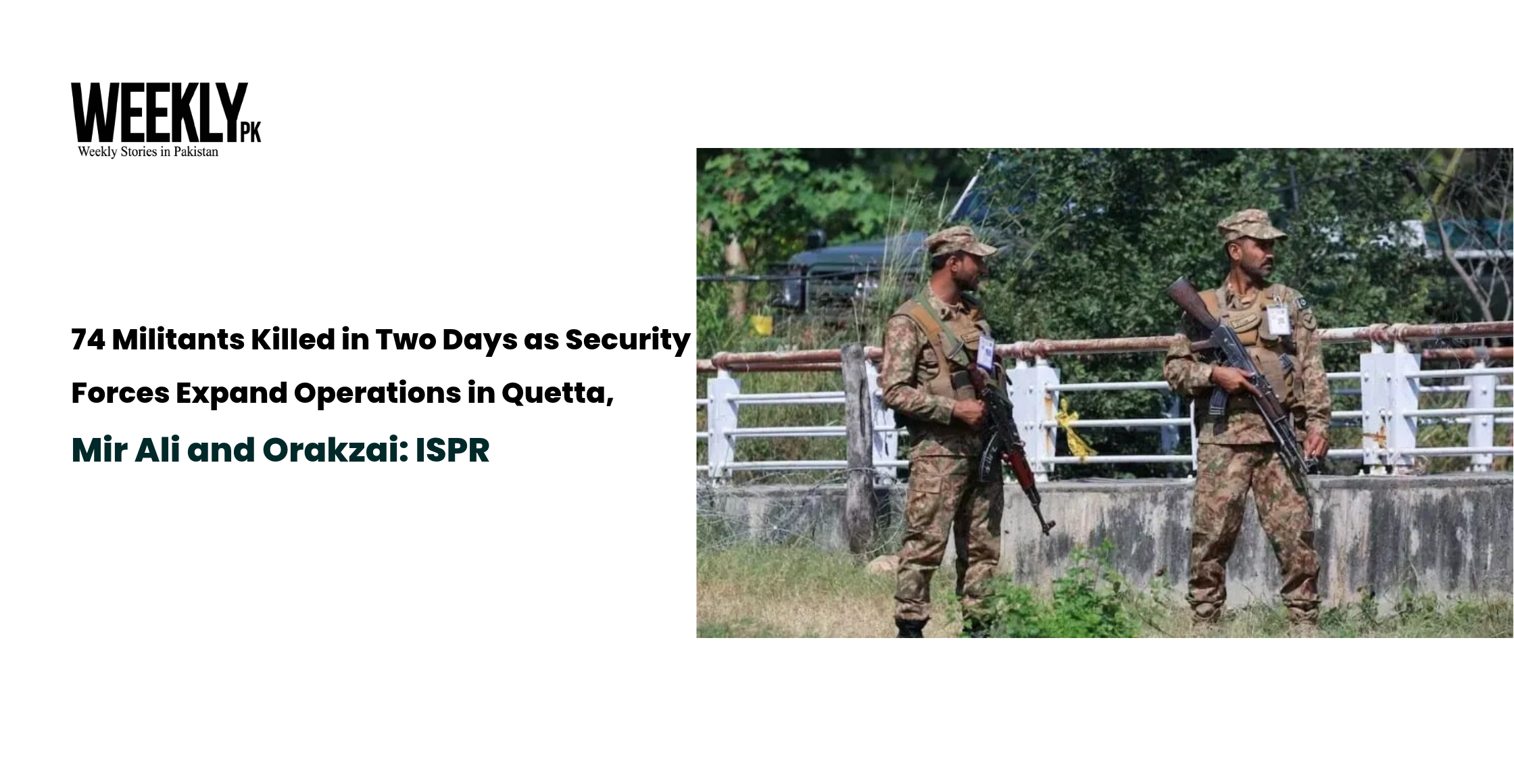
Pakistan’s security forces have killed 74 militants in intelligence-based operations across Balochistan and Khyber Pakhtunkhwa, the military’s media wing said on Friday, in one of the largest announced tolls of recent weeks. The announcement came two days after a deadly ambush on police in Kohat and as the army expands operations into new districts of the province.
According to the Inter-Services Public Relations (ISPR), 43 militants were killed in Khyber Pakhtunkhwa over the past 48 hours, 35 of them in Mir Ali in North Waziristan and eight in Orakzai district. The ISPR said the operations followed intelligence reports and had been expanded to Mir Ali and Orakzai as part of a series of intelligence-based operations aimed at dismantling networks of the group the military calls Fitna al-Khawarij. It said that after intense and fierce exchanges of fire, the militants were neutralised, and that clearance operations were continuing to remove any remaining militants from the areas, according to Samaa.
In Balochistan, the military said security forces had killed 31 militants since November 3 during what it called a comprehensive intelligence-based area sanitisation operation in the Kurram area of Quetta district. The ISPR said the operation targeted elements of what it describes as India-backed Fitna al-Khawarij and Fitna al-Hindustan, and that large quantities of weapons, ammunition and explosives were recovered. Some outlets spelled the location as Karam, but Dawn and ARY News give it as the Kurram area of Quetta. The ISPR said operations would continue until terrorism was eliminated and those responsible for disrupting peace were brought to justice. The statements did not say whether any security personnel were killed or wounded in the operations, and the casualty figures and the description of the militants as India-backed come from the military and have not been independently verified.
The announcement fits a pattern that has grown more frequent. In late September, the military reported that more than 71 militants had been killed over 96 hours in Balochistan across Operation Shaban and raids in Nushki and Mand. In October, an assessment carried by the Associated Press of Pakistan said 67 major operations over three to four years had killed over 50 militants of Islamic State Khorasan Province and led to more than 100 arrests. On Wednesday, 10 police personnel, including a deputy superintendent, were martyred and 18 militants killed in Kohat when a police party was ambushed after an operation against illegal gold mining. The latest figures bring the total reported killed in operations over the last two days to more than the total from the Kohat clash.
The operations come amid a rise in violence. According to the Pakistan Institute for Conflict and Security Studies (PICSS), 49 militant attacks were recorded nationwide between October 30 and November 5, compared with 31 attacks in the preceding week, as reported by Minute Mirror. That increase of nearly 60% in a week is notable, though it covers a short period and weekly figures can fluctuate. The data suggest that the military’s offensive is taking place in a period of heightened militant activity rather than after a lull.
Also Read: Over 71 Militants Killed in Balochistan as Operation Shaban Enters Sustained Clearance Phase
The geographic spread is significant. Mir Ali in North Waziristan and Orakzai in Khyber Pakhtunkhwa are both areas that have seen repeated military action and, in Mir Ali’s case, a number of attacks on security forces in recent years. Quetta district in Balochistan is an area where the military has conducted operations since early this month, and the Kurram area there should not be confused with Kurram district in Khyber Pakhtunkhwa. The operations reflect what the military describes as a comprehensive approach to dismantling networks, and the government has linked this effort to the emergency imposed in Khyber Pakhtunkhwa, arguing that coordinated security action is needed. On Sunday, the administration running the province announced a Rs70 billion plan to strengthen the police and Counter-Terrorism Department, which it said were short of more than 10,000 personnel.
There are also open questions about what such announcements can and cannot show. Operational totals are an indicator of activity, not necessarily of progress in reducing violence, and the sources available do not allow independent confirmation of the numbers. Journalists and researchers have limited access to the areas where the operations are taking place, and details about the identities of those killed, how the operations were carried out and what losses the forces suffered are typically not published. Critics often argue that high body counts alone do not measure success and that attention to governance, policing and economic conditions in affected areas is necessary for lasting results, while supporters say sustained pressure is required to prevent militants from regrouping. Both arguments are likely to feature in the continuing debate.
What happens next will depend on whether the clearance operations in Mir Ali and Orakzai produce further casualties, whether militants respond with retaliatory attacks, as they did in Kohat, and whether the weekly attack figures recorded by independent trackers rise or fall. The military says the operations will continue, and there is nothing in the statements to suggest a pause.
Compiled by the Weekly PK Security Desk.
Leave a Reply