
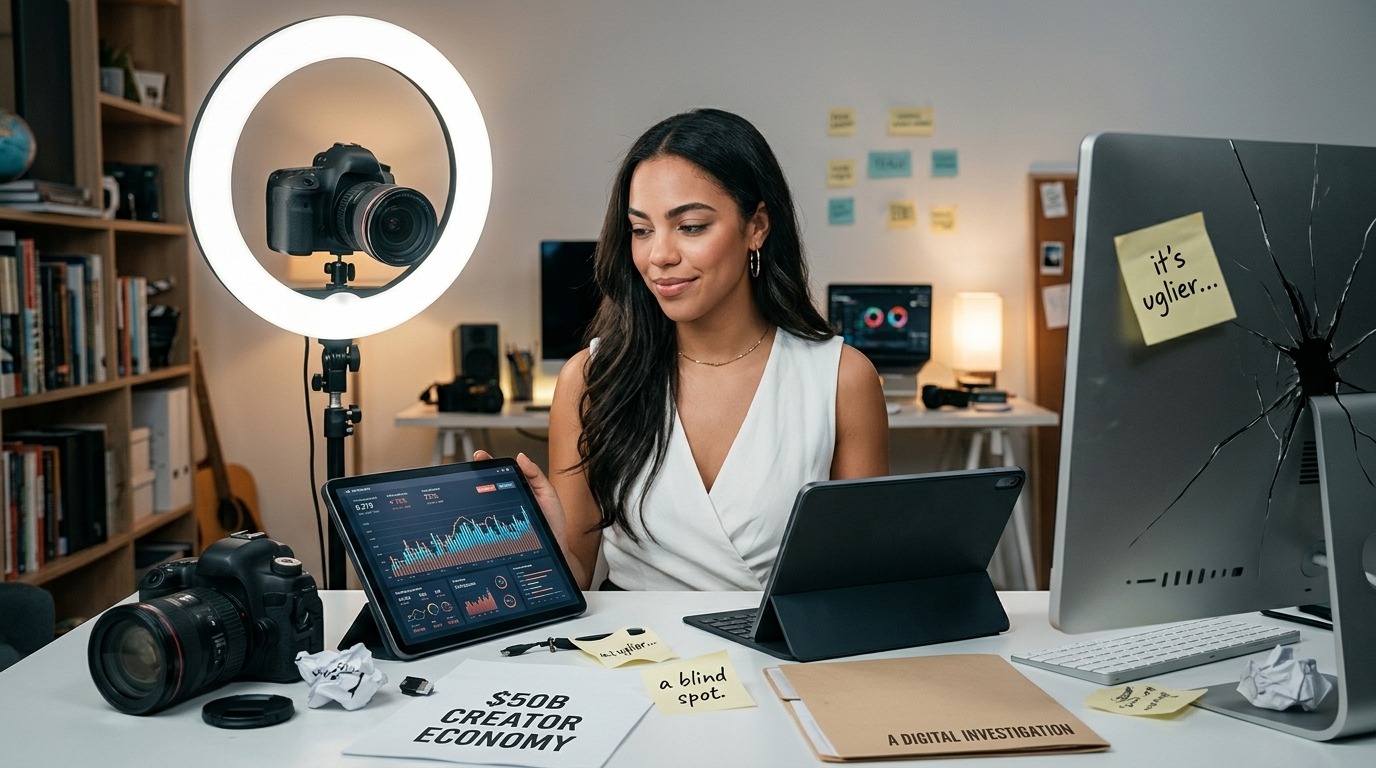
The global creator economy is now valued at somewhere between $235 billion and $323 billion, depending on who you ask and how broadly you define it. Goldman Sachs projects it will approach $480 billion by 2027. Every major platform is racing to capture it. Every brand wants a piece of it. And every Western trade publication is writing the same story: the creator economy is the future of work, the democratisation of media, the great leveller.
But there is a version of this story that almost nobody is telling and it comes from the markets where the creator economy didn’t so much arrive as mutate.
Pakistan has over 60 million active TikTok users and 70 million on YouTube. It is one of the world’s youngest populations, with nearly 65 percent of its people under the age of 30. The conditions for a thriving creator economy are, on paper, ideal. And yet, what has emerged is not the trust-based, community-driven model that Western media tends to celebrate. It is something stranger, more commercial, and in many ways more honest about what the creator economy actually is when you strip away the Silicon Valley mythology.
In the West, the creator economy mythology goes something like this: a person builds a genuine audience around a genuine passion, earns trust over time, and eventually monetises that trust through brand partnerships, merchandise, or subscriptions. The audience is the asset. The relationship is sacred.
In Pakistan, this developmental arc was largely skipped. The market went from near-zero to hyper-commercial almost overnight, driven by a combination of smartphone penetration, graduate unemployment topping 30 percent, and a cultural moment in which being an influencer became one of the few visible pathways to financial mobility for young people with ideas but limited institutional options.
What filled the trust vacuum was something else: volume, visibility, and increasingly aggression. Pakistani influencer communities have developed a reputation for being among the most commercially transactional and, in some cases, actively hostile online spaces. Creators with large followings have leveraged those numbers not to build communities but to enforce hierarchies, bullying smaller creators, manufacturing controversies for engagement, and trading in the performance of authority rather than its substance.
The result is a creator economy in which clout has replaced craft, and brands eager for reach in a fast-growing market have, knowingly or not, funded the whole thing.
It would be convenient to frame this as a uniquely Pakistani problem, a symptom of a young, under-regulated market finding its feet. But the more uncomfortable truth is that the brands doing business in these markets are not passive observers. They are active participants.
When brands select influencers based primarily on follower count which most brands still do, despite years of industry guidance to the contrary they reward exactly the behaviours that have corroded trust in the first place. Manufactured authority is invisible to a brand buying impressions. What shows up in the spreadsheet is reach, engagement rate, and cost per activation. What doesn’t show up is whether the creator’s audience actually trusts them, respects them, or would act on anything they say.
Pakistan’s National Cyber Crimes Investigation Agency, created in 2024, has already opened cases into undisclosed sponsorships, misleading advertising, and the promotion of illegal gambling platforms by influencers. These are not edge cases; they are symptoms of a market where the incentive structures have been pointing in the wrong direction from the beginning, and where the brands writing the cheques have rarely asked hard questions about what, exactly, they are funding.
There is another dimension to this story that the creator economy’s boosters prefer not to linger on: who is actually making money.
Globally, only 4 percent of creators earn more than $100,000 a year. Half earn less than $15,000. In Pakistan, the numbers are starker: according to the Pakistan Telecommunication Authority’s 2025 report, fewer than 2 percent of digital creators earn above a professional wage level. The creator economy, in other words, is a winner-takes-most market and in markets like Pakistan, where the structural conditions were already unequal, the spoils are even more concentrated.
For the tens of millions of young Pakistanis who entered this space looking for the financial mobility the creator economy promised, the reality has been a lesson in how quickly aspiration becomes exploitation. The platforms benefit from the content. The brands benefit from the reach. The top 2 percent of creators benefit from the deals. Everyone else is producing content for free.
In August 2026, the Pakistan Influencer Awards launched in Karachi the country’s first industry-backed, data-driven platform designed to evaluate creators on measurable impact, authenticity, and genuine community influence rather than follower count. It is a meaningful initiative, and the fact that it exists at all is an acknowledgment that the current model is broken.
The launch also quietly confirms something that the Western creator economy discourse rarely admits: that follower-based metrics are a poor proxy for influence, that popularity and trust are not the same thing, and that the industry has been rewarding the wrong things for long enough that it now needs a formal corrective mechanism.
This is not a uniquely Pakistani reckoning. The same conversation is happening, at different speeds and under different pressures, in Nigeria, Indonesia, Brazil, and every other market where the creator economy arrived fast and without adequate infrastructure. What makes Pakistan interesting is how quickly the contradictions became visible and how much the rest of the industry could learn from looking at them honestly.
The creator economy’s blind spot is not geographic. It is not about which markets are covered and which are ignored, though that is part of it. The deeper blind spot is about what the creator economy actually is, versus what we have chosen to believe it is.
In markets like Pakistan where the mythology arrived without the infrastructure, where the promise of financial mobility collided with structural inequality, and where the incentive systems were never designed to reward trust the creator economy looks less like a revolution and more like a familiar story: a new system that concentrates value at the top, extracts labour from the many, and calls the whole thing opportunity.
The $323 billion figure will keep growing. The reports will keep celebrating it. And in markets across the Global South, the people who were supposed to benefit most from the creator economy will keep producing content for platforms that were built for someone else, for brands that measure them in impressions, and for audiences that have learned sometimes the hard way that a large following and genuine authority are not the same thing.
Until the industry is willing to look at that honestly, the blind spot will remain and it will keep getting bigger.
Leave a Reply