
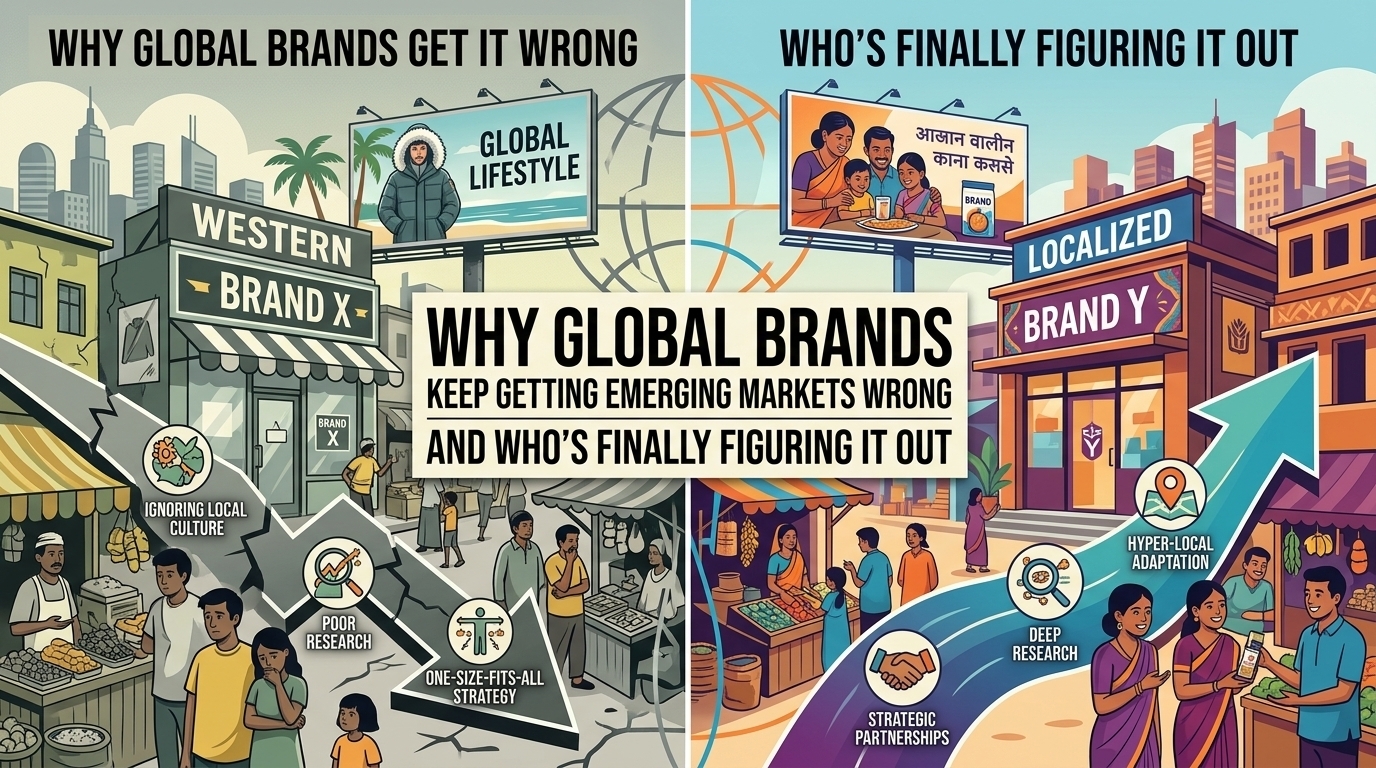
There is a particular kind of corporate confidence that travels badly. It shows up in boardrooms in New York, London, and Düsseldorf, gets packaged into a market entry strategy, and then lands in Lagos, Karachi, or Jakarta with the quiet certainty that what worked at home will work anywhere. It almost never does.
Emerging markets are set to contribute nearly 65 percent of global economic growth by 2026, growing almost three times faster than advanced economies. They are, by any measure, the most important commercial frontier of this decade. And yet the brands that should be winning in these markets are losing, not to each other, but to local competitors who understand something that the multinationals consistently miss: that a market is not just a geography. It is a culture, a set of values, a history of relationships between people and the things they buy.
The failures are not subtle. When Home Depot entered China in 2006, it did not occur to anyone at the company’s Atlanta headquarters that Chinese consumers, particularly in a developing economy, might associate DIY home renovation with poverty rather than weekend leisure. By 2012, after opening 12 stores and absorbing a $160 million after-tax loss, the company pulled out entirely. When Pepsodent ran campaigns in parts of Southeast Asia promoting teeth-whitening, it had not considered that in Indonesia and Myanmar, where betel nut chewing is culturally embedded, blackened teeth are a mark of social status. The campaign did not just underperform. It actively alienated the people it was trying to sell to. When Dolce and Gabbana released a promotional video in China showing a Chinese woman struggling to eat Italian food with chopsticks, the backlash was so swift and so total that the brand has never fully recovered in that market. Products were pulled from e-commerce platforms. Celebrities canceled contracts. Years later, being seen wearing D&G in certain circles remained reputationally complicated.
These are not obscure cautionary tales. They are well-documented, widely cited, and apparently insufficient to change behavior. Global brands keep making the same category of mistake, not because they are unaware that cultural context matters, but because they do not have adequate mechanisms for letting that context change their decisions.
The deeper problem is structural. Most global brands build their marketing strategies at the center and then adapt them at the edges. Localization, in this model, is something that happens to a strategy after it has already been decided. A translation exercise, a palette swap, a few culturally appropriate faces in the campaign imagery. What it is almost never allowed to be is a fundamental rethinking of the product, the positioning, or the promise.
Research from Frontiers in Psychology looking at consumer behavior in Pakistan and China found something that should trouble every global marketing team: in Pakistan, consumer perceptions of brand globalness actually negatively influenced brand attitude. Meaning that in this market, being seen as a global brand was, in certain categories, a disadvantage. Consumers were not aspiring to the foreign. They were skeptical of it. The brands that performed better were those perceived as understanding the local, as being of the market, not merely in it.
This is a finding that runs directly counter to the implicit assumption behind most global brand strategies, which is that the cachet of Western origin is itself a form of competitive advantage. In some markets, at some price points, it still is. But in a growing number of emerging markets, that assumption is aging badly. Local brands have gotten better. Local competitors have gotten smarter. And local consumers have gotten more discerning.
IKEA’s entry into China is an instructive case study in how even a sophisticated global retailer can misread a market at multiple levels simultaneously. Its low-price marketing strategy, the same one that had made it dominant in Europe, failed because in China, Western products carry aspirational associations. Consumers did not want cheap IKEA. They wanted IKEA as a status object, priced accordingly. Meanwhile, the company’s catalogue became a reference document for local manufacturers to copy its products and undercut it on price. The brand found itself undercut from below and mispositioned from above at the same time. Burger King’s experience in Vietnam followed a similar logic: a standard menu that worked in Kansas could not compete with local street food that was faster, cheaper, and better adapted to local taste. The company was eventually forced to reposition its restaurants as experience destinations, a more expensive strategy that it would not have needed if it had understood the market before entering it.
The brands that are getting this right are doing something structurally different. They are not adapting global strategies for local markets. They are building local strategies from local insight and then integrating those into a global framework. This requires a different kind of organizational design, one where local market teams have genuine decision-making authority, not just implementation responsibility. It requires hiring people who understand the market from the inside, not just consultants who can describe it from the outside. And it requires a willingness to accept that the product, the pricing, the positioning, or all three may need to be fundamentally different in a market that is fundamentally different.
Walmart’s failure in South Korea is perhaps the clearest illustration of what happens when this willingness is absent. The company entered the market and stuck to its standard formula. Western marketing strategies, a focus on dry goods, the same store experience it offered in Missouri. Local competitors understood that South Korean consumers wanted fresh produce, smaller quantities, and a shopping experience calibrated to local habits. Walmart did not adapt. It lost. It eventually sold its South Korean stores and exited the market entirely.
The lesson is not complicated, but it is consistently ignored: markets are not interchangeable. Emerging markets in particular, which are often discussed as a single category despite containing some of the most culturally, economically, and historically distinct populations on earth, reward brands that take them seriously on their own terms. The brands that will win the next decade of emerging market growth are not the ones with the biggest budgets or the strongest global recognition. They are the ones that are willing to sit in the discomfort of not knowing, ask questions instead of making assumptions, and build strategies that start with the market rather than ending there.
That is a different kind of confidence from the kind that travels badly. It is rarer. It is harder to manufacture in a boardroom far from the market. And in the next decade of global economic growth, it will be the difference between winning and another quietly expensive exit.
Leave a Reply