
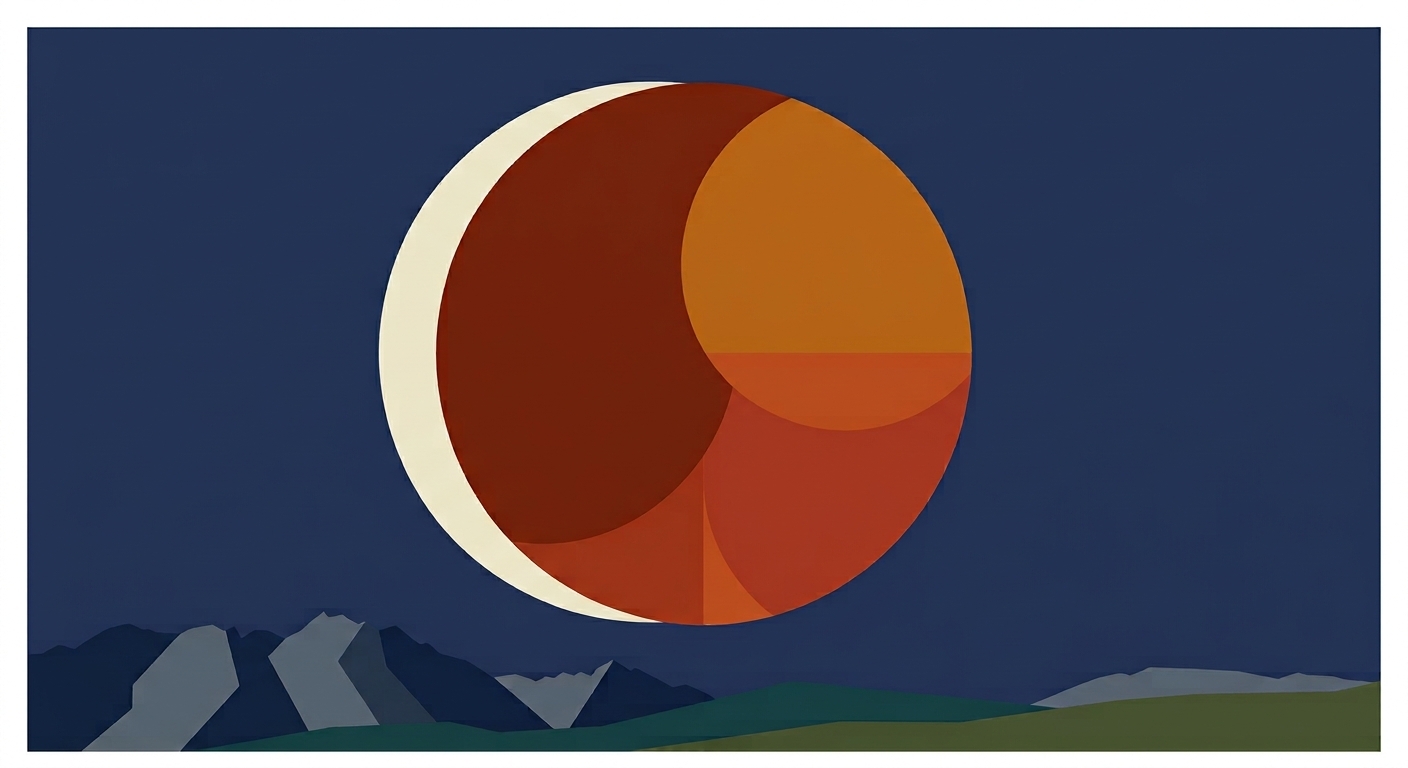
Skywatchers around much of the world are preparing for a deep partial lunar eclipse on the night of August 27 into the early hours of August 28, an event some coverage is already labelling a blood moon even though the label does not really apply to what is about to happen. According to Pakistan Observer, citing timing data for the event, the eclipse will not be observable from Pakistan, since the Moon will already have set or will not yet have risen during the relevant window from this part of the world, a point Pakistani skywatchers will want to keep in mind before making any viewing plans for the night.
The eclipse itself is a genuinely unusual one by the standards of the current decade. NASA’s decade table of lunar eclipses, compiled by Fred Espenak for the agency’s Goddard Space Flight Center, lists the eclipse’s umbral magnitude at 0.930, meaning 93 percent of the Moon’s diameter will slide into the darkest, innermost part of Earth’s shadow at the moment of greatest eclipse. Among all partial lunar eclipses occurring between 2021 and 2030, only one goes deeper, an eclipse in November 2021 that reached a magnitude of 0.974. The August 27 event belongs to Saros series 138, a family of eclipses that repeats roughly every eighteen years and eleven days.
Understanding why the Moon will look bitten rather than blood red requires understanding the two shadows Earth casts into space. The umbra is the dark, cone-shaped inner shadow where Earth blocks the Sun’s disc completely. Around it lies the penumbra, a much broader and fainter shadow where Earth blocks only part of the Sun, allowing a good deal of sunlight to still reach the Moon. During a partial eclipse, part of the Moon sits inside the umbra while the rest remains in the penumbra, and the visual contrast between the two regions can be dramatic. Astronomers Espenak and Meeus, writing in NASA’s Five Millennium Canon of Lunar Eclipses, describe the portion of the Moon inside the umbra as typically appearing very dark, almost black, largely because of contrast, noting that the remaining sliver still catching direct sunlight from the penumbra can be brighter by a factor of roughly 500.
That figure describes the general case for partial eclipses rather than a firm prediction for this particular one, and the August 27 event has a quirk that complicates the comparison. Its penumbral magnitude works out to 1.965, meaning the entire lunar disc will sit inside the penumbra at the moment of greatest eclipse. That means the surviving sliver of the Moon, the part that stays outside the umbra, will itself be somewhat dimmed by penumbral shading rather than catching full, undiminished sunlight, which likely brings the real contrast down from the roughly 500-fold figure typically cited for partial eclipses in general. Even so, the difference between the dark umbral portion and the brighter remaining sliver is expected to be large enough that a naked eye adjusting to the bright edge would have little chance of registering any subtle colour in the shadowed portion beside it.
The reason total lunar eclipses turn red while deep partial ones like this one generally do not, comes down to how much of the Moon is fully immersed in the umbra. During a total eclipse, none of the Moon receives direct sunlight, and the only light reaching the lunar surface has been bent through Earth’s atmosphere on its way there, a process that scatters away shorter wavelengths of light and lets the oranges and reds pass through and reach the Moon, producing the reddish glow associated with the phrase blood moon. On August 27, the Moon never becomes fully immersed in Earth’s umbra, stopping at 93 percent of its diameter, so the classic reddish tint of a total eclipse is not expected to be the dominant visual effect this time. Observers in regions where the eclipse is visible are more likely to see a sharp, dark curve cut deep across most of the lunar disc, with a comparatively bright, thin crescent remaining along one edge, rather than a uniformly tinted Moon.
Much of the coverage of this eclipse circulating online has cited a 96 percent figure rather than the 93 percent umbral magnitude published by NASA, and the discrepancy is worth clarifying since both numbers are technically accurate but describe different things. Umbral magnitude measures the fraction of the Moon’s diameter, essentially its width, that falls inside the umbra at greatest eclipse. Obscuration, by contrast, measures the fraction of the Moon’s visible surface area covered by the umbra. Because the umbra’s edge cuts across a circular disc, area disappears faster than width does as the shadow deepens, which is why the two figures diverge for an eclipse this deep. According to calculations from timeanddate.com, obscuration for this event works out to roughly 96.2 percent even though the umbral magnitude remains 0.930. Neither number is wrong, but the 93 percent width figure is the one that actually describes how much of the Moon’s diameter will vanish into shadow, while 96 percent describes coverage by surface area, a distinction that matters because the area figure can make the eclipse sound as though the Moon will nearly disappear altogether, when in fact a visible rim survives around the disc’s edge.
The Earth’s umbra is typically around 2.7 times wider than the Moon itself, according to the same NASA canon, which is part of why the shadow’s edge appears as a smooth, curved bite rather than a straight line, and why such a large share of the Moon’s width can disappear into darkness while a slim crescent survives along one limb.
For observers positioned where the eclipse is visible, the event unfolds over several hours. In universal time, the sequence runs as follows: the penumbral phase begins at 01:24 on August 28, the partial phase begins at 02:34, greatest eclipse occurs at 04:13, the partial phase ends at 05:52, and the penumbral phase concludes at 07:02. The partial phase itself, when the umbra is visibly biting into the lunar disc, lasts roughly three hours and eighteen minutes. The eclipse is expected to be visible across large parts of Europe, western Asia, Africa, and North and South America, along with sections of the Pacific, Atlantic and Indian Oceans, according to reporting on the event’s global visibility.
For Pakistan specifically, the picture is different. According to Pakistan’s earlier eclipse reporting for 2026, skywatchers in the country will not be able to observe the August event at all, since the relevant window falls outside the hours when the Moon is above the horizon locally. This would mark the final lunar eclipse of the year globally, following an earlier partial lunar eclipse on March 3 that was partially visible from Pakistan around moonrise, and it comes roughly two weeks after a total solar eclipse crossed parts of the Northern Hemisphere on August 12, an event that was itself not visible from Pakistan. Pakistani skywatchers hoping to catch a lunar eclipse locally will need to wait for a future event that falls within viewing hours from the region, with the next currently listed lunar eclipse events for Pakistan occurring over the coming years.
One advantage of lunar eclipses generally, unlike solar eclipses, is that they are entirely safe to observe directly with the naked eye, requiring no special glasses, filters or equipment of any kind, since the Moon itself is not a source of the intense light that makes solar eclipse viewing hazardous. For those positioned in regions where the eclipse will be visible, no preparation beyond finding a clear view of the sky and checking local moonrise and moonset times is required.
Beyond its visual spectacle, this kind of eclipse carries a much older significance in the history of science. In the fourth century BCE, the Greek philosopher Aristotle compared observations of several lunar eclipses and noted that the curved edge of Earth’s shadow on the Moon looked the same every time, regardless of where in the world the eclipse was observed or how high the Moon stood in the sky. He reasoned that only a sphere could cast a round shadow consistently from every angle, arguing that the shape of the shadow itself was evidence that Earth was round. It is remembered as one of the earliest recorded proofs of a spherical Earth, built entirely from patient observation of a dark arc crossing a bright lunar disc.
Whether observers under a clear sky in regions where the eclipse is visible will detect any hint of colour along the eclipse’s inner edge near the moment of greatest eclipse remains difficult to predict with certainty. The NASA canon’s general guidance for partial eclipses describes the shadowed portion as typically appearing very dark or black rather than distinctly coloured, even as some recent coverage has suggested viewers might catch a faint orange or copper tint. Astronomers note that the outcome on any given night depends heavily on local atmospheric conditions, and that no published table can forecast that particular detail in advance. What is certain, based on the calculations published by NASA and confirmed by multiple eclipse-tracking sources, is that this will be one of the deepest partial lunar eclipses of the decade, producing a dramatic, sharply bitten Moon for those positioned to see it, even if Pakistan will not be among the regions catching the view this time around.
Leave a Reply