
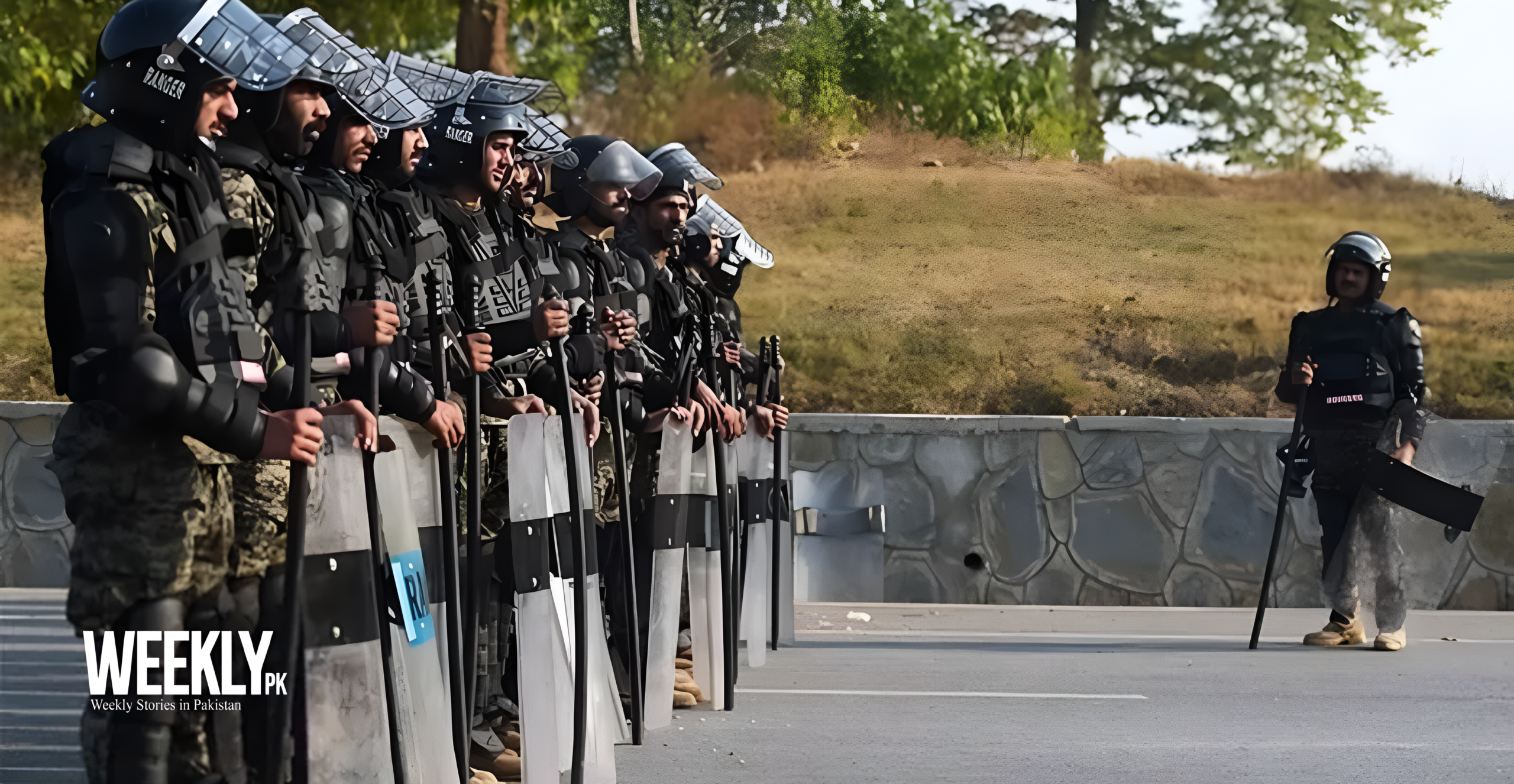
The federal government has approved the deployment of Pakistan Rangers across Islamabad Capital Territory and several Punjab districts ahead of Pakistan Tehreek-e-Insaf’s planned march on the federal capital scheduled for September 27, as security preparations in the twin cities intensify into one of the largest law-enforcement mobilisations the region has seen in recent years. The PTI march, framed by the party as a demand for Imran Khan’s release, has triggered a government response that now spans multiple provinces, tens of thousands of security personnel and a wave of pre-emptive arrests.
According to a notification issued by the Ministry of Interior and Narcotics Control, the deployment will remain in place from September 20 to October 5, authorised under Sections 7(b) and 10 of the Pakistan Rangers Ordinance, 1959, and Sections 4 and 5 of the Anti-Terrorism Act, 1997. The notification states that the deployment follows requests made by the Islamabad chief commissioner and Punjab’s Home Department, and that Rangers personnel may respond appropriately in self-defence to any threats or violent activity encountered while carrying out their duties. The Ministry separately directed that Rangers and police take all necessary counter-action in the event of attacks by disruptive or armed groups, language that signals authorities are preparing for the possibility of direct confrontation rather than a purely preventive posture.
In Punjab specifically, the provincial government requested Rangers deployment in Rawalpindi, Attock, Jhelum and Mianwali, with the request covering the period from September 22 through October 5. The breakdown of forces assigned to each district gives a sense of where authorities expect the heaviest pressure from the PTI march: three Rangers companies have been designated for Rawalpindi, five wings for Attock, and one company each for Jhelum and Mianwali. The concentration of forces in Attock and Rawalpindi in particular reflects their position as key transit points on routes leading into the federal capital, making them natural chokepoints for any large-scale movement of PTI supporters and vehicles. Section 144, which restricts public gatherings, has also been imposed across Islamabad and several areas of Punjab as part of the broader security posture heading into the march, effectively criminalising unauthorised assemblies in the very areas where PTI has signalled it intends to mobilise supporters.
The scale of the overall mobilisation extends well beyond the Rangers deployment alone. More than 22,000 security personnel are being stationed in the capital, with authorities placing shipping containers at key entry points and along major roads to restrict movement into Islamabad, a tactic that has become a familiar feature of how Pakistani authorities have managed previous large political mobilisations, including past PTI marches and sit-ins. Aerial images from September 24 showed the Islamabad-Peshawar Motorway already blocked with trucks positioned by authorities, a measure aimed squarely at slowing or preventing PTI convoys from Khyber-Pakhtunkhwa from reaching the capital. Given that K-P remains one of PTI’s strongest bases of support and the province from which the party has historically drawn large numbers of marchers, cutting off or significantly delaying that route represents one of the government’s most consequential moves so far. Preparations are also reportedly underway to close the only mountain route connecting K-P with Islamabad, a step that would cut off one of the more direct paths PTI supporters travelling from the province might otherwise use to join the march, effectively leaving convoys with longer, more easily monitored roads as their only options.
The security build-up around the PTI march has coincided with a wave of arrests and detentions targeting party leaders, activists and supporters across both Islamabad and Punjab, part of what authorities describe as an effort to pre-empt disruption before it materialises. That pattern has included the detention of three of Imran Khan’s sisters, Aleema Khan, Noreen Niazi and Uzma Khan, under the Maintenance of Public Order Ordinance earlier this week, in what PTI leadership has characterised as a direct, personal escalation against the former prime minister’s family rather than a routine law-and-order measure. The detentions have drawn criticism from PTI supporters and some human rights voices, who argue that targeting family members who hold no formal party office represents a marked shift in how the state is choosing to apply pressure ahead of the march, moving beyond the usual targeting of party office bearers and workers.
Dawn has learnt that PTI has been told in clear terms that the federal government will not allow the march to proceed as planned. According to leaders familiar with the discussions, the party has been offered certain confidence-building measures through backchannel contacts, though accounts from the two sides differ considerably on how substantive those contacts have actually been. Prime Minister’s Adviser on Political Affairs Rana Sanaullah said no formal talks with PTI could take place until the long march itself was postponed, a precondition that has so far left negotiations at an impasse and that PTI has been reluctant to accept, given that postponing the march without any concrete concession in return would likely be read by its own base as a retreat. PTI Chairman Barrister Gohar Ali Khan, for his part, has said the party remains open to dialogue and that it has conveyed its position through ongoing contacts at the federal level, even as preparations for the march itself continue unabated, a dual track approach that has left both sides publicly signalling openness to talks while making almost no visible progress toward an actual de-escalation.
Authorities have also signalled they are prepared to restrict digital communications if the situation on the ground requires it. The Pakistan Telecommunication Authority has been checking backup power arrangements to maintain mobile services amid potential loadshedding, though officials have said no final decision has yet been made on whether mobile internet will be shut down during the march itself, a measure that has been used during past large-scale protest mobilisations in Pakistan to limit organisers’ ability to coordinate in real time. Internet restrictions of this kind have proven controversial in previous instances, drawing criticism from digital rights groups and businesses that rely on connectivity, even as security officials have defended the practice as a necessary tool for preventing rapid, large-scale gathering of marchers at short notice.
PTI has framed the September 27 march as a demand for the release of Imran Khan, imprisoned since August 2023 and facing multiple ongoing cases, along with what the party describes as the restoration of constitutional supremacy more broadly. The party has held several large-scale marches and protest actions since Khan’s imprisonment, with varying degrees of success in actually reaching Islamabad or achieving their stated aims, and the government’s current scale of preparation suggests officials are treating this particular mobilisation as a more serious test than some of the party’s previous attempts. Whether that assessment reflects genuine intelligence about the scale of expected turnout, or simply a more cautious posture following past instances where security planning was seen as inadequate, remains unclear from the outside.
With Rangers now formally authorised for deployment through October 5, containers already in place on key motorway routes, and backchannel talks yielding little visible progress, the coming days are shaping up as one of the more consequential tests yet of how far the government is willing to go to prevent the PTI march from reaching Islamabad, and how the party intends to respond if it does not. The outcome is likely to have implications well beyond the march itself, shaping the broader trajectory of the standoff between PTI and the federal government heading into the final months of the year, and testing both sides’ capacity to either force a breakthrough or settle into another prolonged period of confrontation without resolution.
Compiled by the Weekly PK Staff Desk.
Leave a Reply