
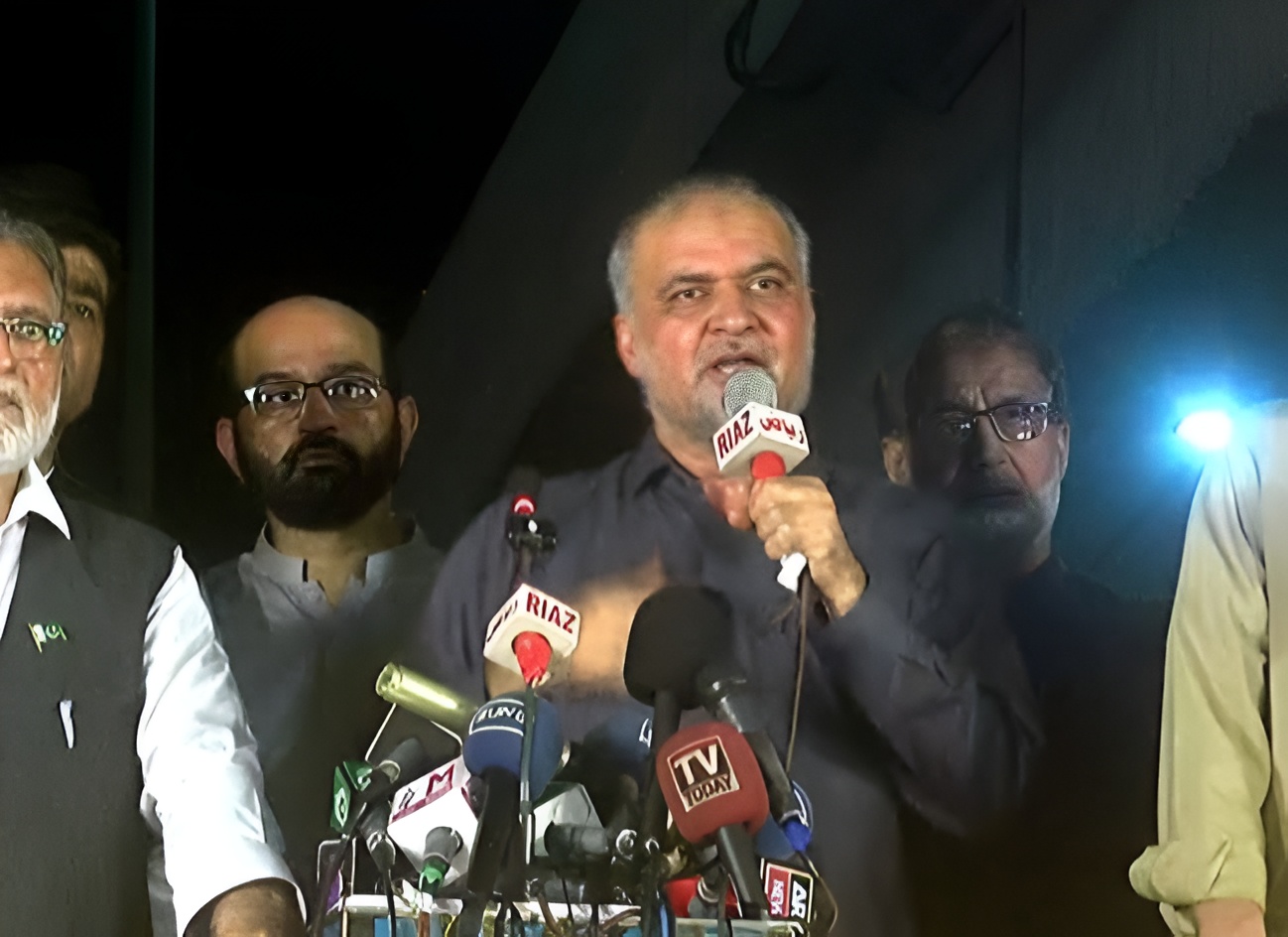
Jamaat-e-Islami launched the next phase of its nationwide campaign against the petroleum levy and rising inflation on Sunday, staging simultaneous sit-ins outside Governor Houses in Karachi, Lahore, Peshawar and Quetta, with party leadership vowing the protests would continue until the government agreed to withdraw the levy altogether.
In Karachi, JI workers marched from different parts of the city toward the Governor House, led by party’s Karachi chief Monem Zafar. The protesters reached the site and staged a sit-in outside the building, pressing the same demands JI has repeated at rallies across the country over the past several weeks: an end to the petroleum levy and relief from what the party has described as an unbearable rise in fuel prices. Police were deployed around Governor House as demonstrators gathered, though authorities confirmed that the road stretching from Fawara Chowk toward the Press Club and Arts Council remained open to traffic throughout the protest, a detail organisers pointed to as evidence the sit-in was being conducted without deliberately paralysing the wider city.
Addressing protesters from a makeshift stage set up on a truck outside Governor House, Zafar issued a direct warning to the Sindh government and police, saying that if authorities chose the path of violence and force to end the demonstration, they would bear full responsibility for whatever followed. He insisted the sit-in would continue regardless of pressure from local administration, arguing that the high price of petrol was affecting every citizen and every sector of the economy, from household budgets to transport and manufacturing costs that ultimately get passed on to ordinary consumers.
Karachi’s demonstration formed one part of a coordinated four-city action that JI had been building toward for days. In Lahore, party workers marched along Mall Road before reaching Faisal Chowk near the Chief Minister’s House, where they set up a sit-in that Punjab JI chief Javed Qasuri and other senior party leaders joined. JI Emir Hafiz Naeemur Rehman himself travelled to the Lahore sit-in, addressing protesters directly and confirming that a parallel demonstration was continuing outside the Governor House in Karachi. Speaking to the crowd at Faisal Chowk, Rehman said the party had launched a protest that would continue until the government withdrew the levy in full, adding that JI intended to keep up its struggle until authorities backed down, an outcome he said he remained confident the sustained pressure of the sit-ins would eventually force.
Rehman also used his remarks in Lahore to dismiss the government’s recent attempt at de-escalation. Responding to claims that a government committee had been formed to examine the issue and engage with JI’s demands, Rehman said the party did not need or want a briefing from the government, a comment that signalled JI’s leadership currently sees little value in negotiating through official channels while the levy remains in place. That posture suggests the party is treating Sunday’s sit-ins not as a one-off pressure tactic but as an extension of a broader campaign it intends to escalate rather than wind down, regardless of procedural gestures from Islamabad.
Sunday’s protests represent the latest escalation in a campaign that has been building since the start of the month. JI had originally planned a nationwide sit-in for August 9, but postponed the action to August 16 to avoid clashing with Independence Day celebrations. Before that, the party staged an earlier, larger round of demonstrations on August 7, when it organised sit-ins and road blockades at roughly 510 locations across the country, disrupting traffic on major highways in cities and towns ranging from Shikarpur and Thatta to Nasirabad and Bela. That earlier round of protests closed sections of the Sindh-Balochistan National Highway and the N-25 near Bela, causing long vehicle queues and significant travel delays, and set the tone for the more targeted, governor-house-focused actions that followed in the second phase.
The substance of JI’s demands has remained consistent throughout the campaign. Rehman has repeatedly accused the government of collecting excessive revenue through the petroleum levy, at one point putting the figure at around Rs130 per litre of petrol, and has argued that global crude oil prices fell earlier this year without any corresponding reduction being passed on to Pakistani consumers at the pump. He has also alleged that federal government expenditure, initially budgeted at around Rs800 billion, had climbed to nearly Rs1 trillion, a claim he has used to argue that the state is financing its own spending increases on the backs of ordinary citizens rather than reducing its own costs. JI has continued to demand that petrol prices be brought down to Rs225 per litre, a figure the party has held to since its first major sit-in earlier this month and has not shown any sign of softening despite the government’s more recent, incremental price reductions.
The choice of Governor Houses as the focal point for Sunday’s protests, rather than the more dispersed, highway-blocking approach used on August 7, appears to reflect a deliberate shift in strategy toward sustained, visible pressure directed squarely at symbols of provincial government authority. By setting up outside the Governor House in Karachi and the Chief Minister’s House in Lahore, JI leadership has positioned the sit-ins as a direct, ongoing challenge to provincial administrations rather than a broader, more diffuse disruption of everyday commuter traffic, even as the party has kept select roads open in a bid to avoid the kind of backlash that came with the more sweeping highway blockades earlier in the month.
Whether Sunday’s sit-ins mark a genuine escalation toward the kind of broader anti-government movement Rehman warned of during the campaign’s earlier phase, or settle into a prolonged but contained standoff outside government buildings, will likely depend on how Sindh and Punjab authorities respond in the coming days. For now, both Zafar in Karachi and Rehman in Lahore have made clear that JI has no plans to wind the protest down voluntarily, leaving the question of how long the sit-ins can continue, and how the government ultimately chooses to respond, as the central unresolved thread heading into the coming week.
Compiled by the Weekly PK Staff Desk.
Leave a Reply