
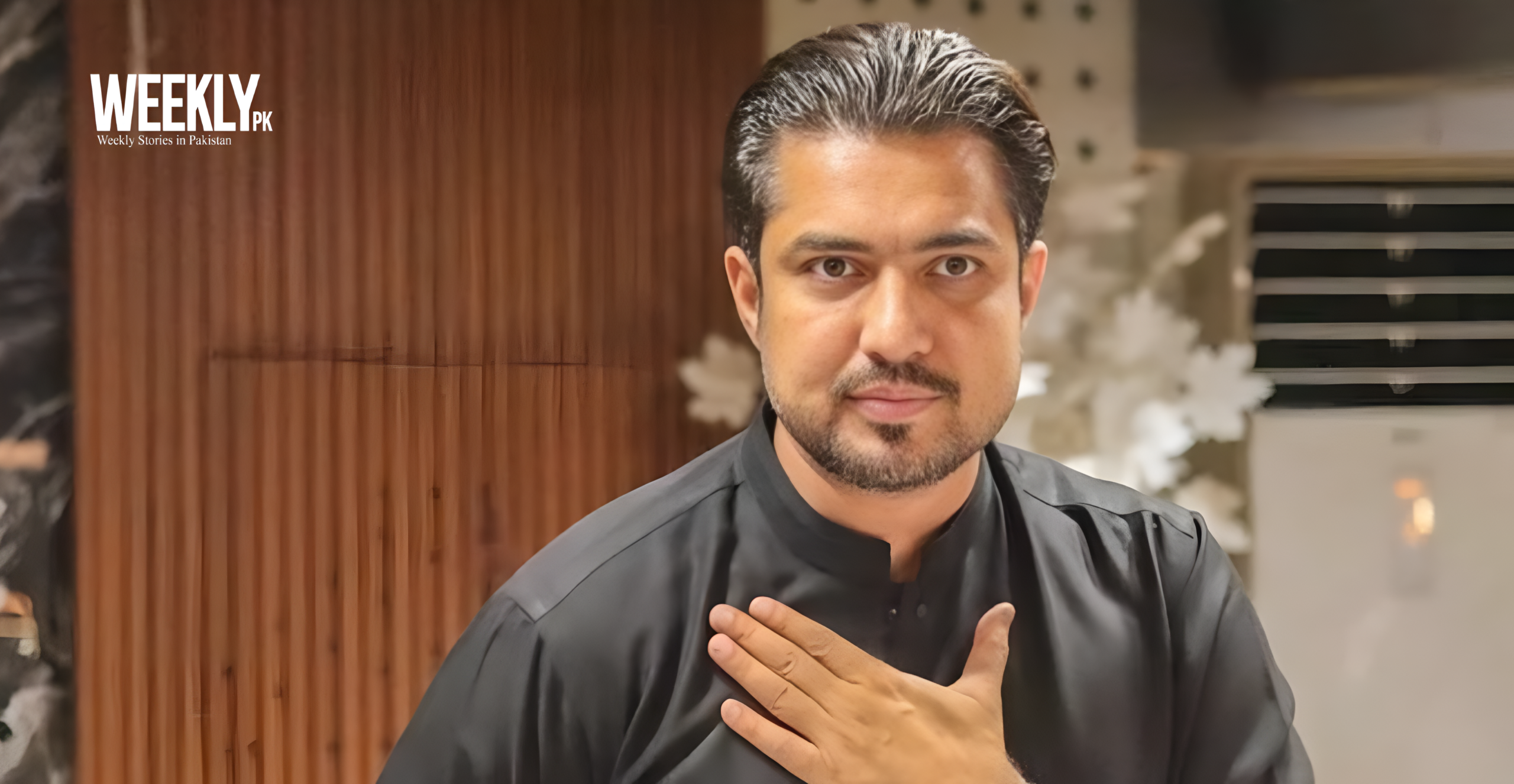
Journalist and Awam Raj Tehreek chief Iqrar ul Hassan has been sent into the custody of the National Cyber Crime Investigation Agency (NCCIA) for four days, a little over a day after his family said he was taken from his Lahore home by unidentified men and that his whereabouts were unknown. The sequence of events, from an alleged pre-dawn raid to a denial of custody and then a court appearance in another city, has raised questions that the authorities have yet to answer in public.
According to his wife, Farah Iqrar, the incident took place at around 3am on Monday, October 12, at the family’s residence in Lahore’s DHA. In a video statement, she said repeated doorbell ringing woke her up, and that when she went to check, several people were already inside the house. She alleged that the group had broken open the main gate, that two women were among them, and that two men grabbed her husband when he came out of his room. She said she was pushed and hurt her hand, and claimed that family members and household staff were mistreated during the operation. Two mobile phones belonging to Iqrar, a laptop and her own phone were taken, she said, along with the home’s DVR, and the CCTV footage was removed. The family also claimed that one of the individuals involved was wearing an NCCIA identification tag.
For much of Monday, nobody said who had taken him. Iqrar’s lawyer, Mian Ashfaq Ali, told reporters that the matter had reached a judicial magistrate, who asked specifically about his custody and production, and that the NCCIA, before the court, “completely denied” holding him. Punjab Information Minister Azma Bokhari separately said the Punjab Police had not arrested him and that the matter was under investigation. His other wife, Quratulain, appealed to Chief Minister Maryam Nawaz to help establish where he was, saying the family had no idea what evidence might be prepared against him, when he would be released, or under what circumstances he had been picked up. His relative Aroosa Iqrar asked how a prominent journalist could be taken from inside a gated society, adding that if it could happen to him, it could happen to ordinary people too.
On Tuesday, the picture changed. A Karachi judicial magistrate remanded Iqrar ul Hassan into NCCIA custody for four days in a case involving alleged online content. According to the agency, he was arrested over allegations of sharing anti-state, false and defamatory material through his official social media accounts. Those are the agency’s allegations, and they have not been tested in court.
Iqrar ul Hassan is a well-known figure, and the case has drawn attention for that reason. He built his career as an investigative reporter and television anchor, and was the subject of a reported attack in Gujranwala in 2024 while working as a journalist. He resigned from ARY News in April 2026 to pursue politics, going on to lead Pakistan Awam Raj Tehreek, a party he launched with the stated aim of bringing political change. He has also been an active voice on social media, where he has frequently criticised government policies. Claims circulating online have linked the case to that online activity and his political involvement, though the authorities have so far pointed only to the content allegation.
The facts so far leave several questions unresolved, and they are worth stating plainly. The first is the gap between Monday and Tuesday. If the NCCIA told a court in Lahore that it did not have him in custody, how did he end up before a magistrate in Karachi the next day? There may be a straightforward explanation, such as a transfer between jurisdictions or a separate case that was not part of the first hearing, but that explanation has not been given publicly.
The second is the legal process. Under Pakistani law, a person taken into custody is expected to be informed of the grounds of arrest and produced before a magistrate within 24 hours. Whether those steps were followed, and when the arrest was formally recorded, is something his lawyers can be expected to raise. It is also unclear which specific case his detention was initially linked to, with his lawyer saying on Monday that he could not confirm it.
The third is the manner of the operation itself. The family’s account of a raid involving a broken gate, seized devices and removed CCTV is an allegation, not an established fact, but it will matter if the court is asked to look at how the arrest was carried out. An operation by a federal agency would normally be expected to come with identification, a written record of what was seized, and a clear statement of who was involved. If the agency’s account differs from the family’s, a judge may want to hear both.
The case also sits within a longer debate about how Pakistan’s cyber crime law is used. The NCCIA has been busy in recent weeks with large operations of a very different kind, including raids on call centres accused of defrauding foreign citizens, and those cases show the agency’s role in tackling financial cybercrime. Cases involving online speech are a different matter. The Prevention of Electronic Crimes Act gives the agency broad powers over online content, and press freedom advocates have long argued that provisions on false or defamatory material can be applied in ways that chill criticism of the government. Supporters of the law counter that online disinformation and defamation cause real harm, and that the agency has a duty to act on complaints. Both positions are likely to be tested as this case progresses, and the outcome may say as much about the law as about Iqrar ul Hassan himself.
For now, the four-day remand means the NCCIA will question him and examine the devices it says were seized, while his lawyers weigh their options, which could include seeking bail or approaching a higher court. The family’s priority, Farah Iqrar has said, is his safety and release. Whether the court will see the case as a straightforward matter of alleged online content, or as something that requires closer scrutiny of how and why he was picked up, is likely to become clearer when he is next produced.
Compiled by the Weekly PK National Desk.
Leave a Reply