
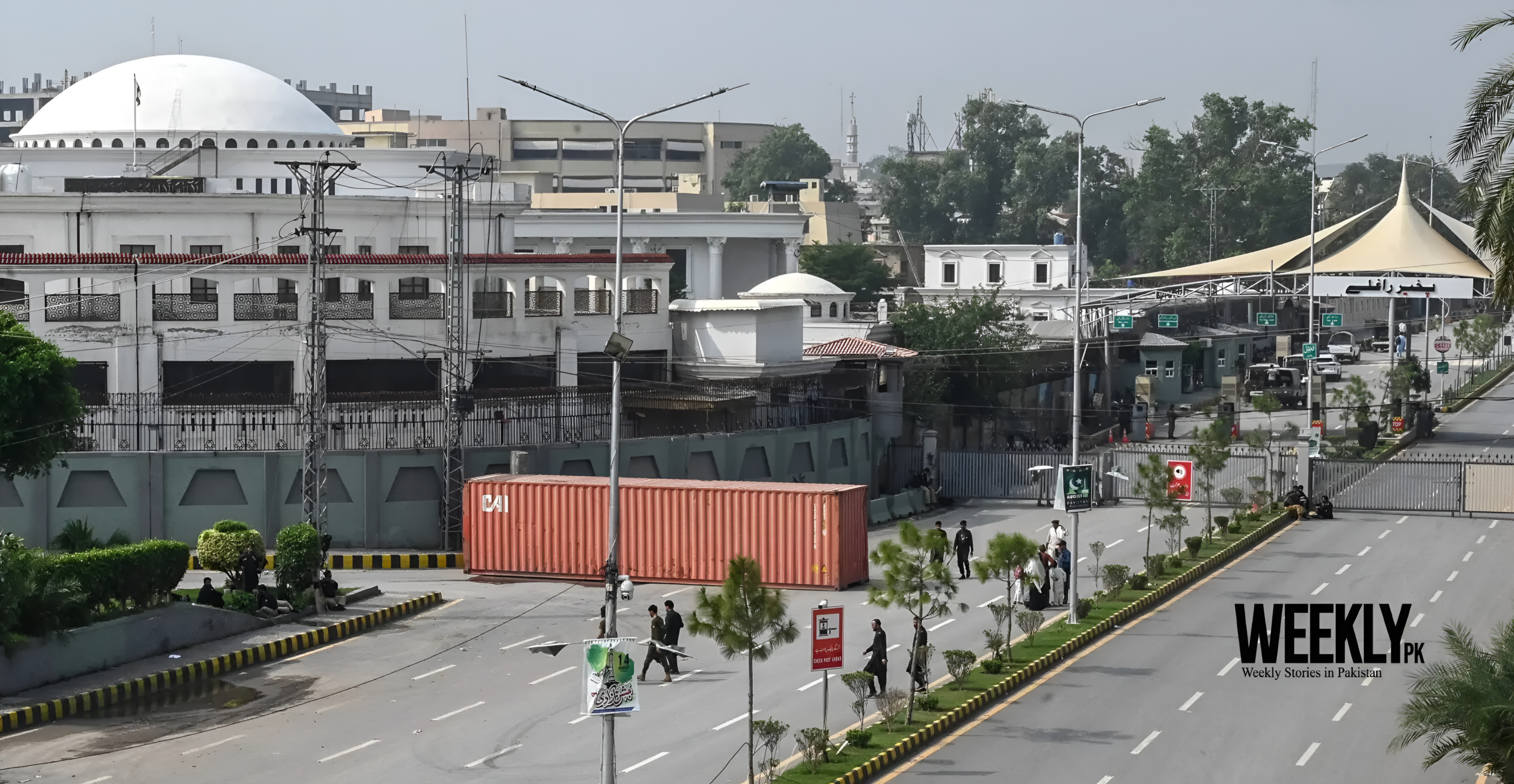
The federal government has imposed an emergency and governor’s rule in Khyber Pakhtunkhwa, placing the province run by Imran Khan’s PTI under direct central oversight in the middle of the party’s long march. Within hours, Chief Minister Sohail Afridi was reported to be in custody, leaving the country facing a constitutional confrontation whose outcome is far from clear.
President Asif Ali Zardari approved the move on Sunday on the advice of Prime Minister Shehbaz Sharif, following an emergency federal cabinet meeting. The President’s Office said the measures were taken under Articles 232 and 234 of the Constitution. The cabinet cited the province’s worsening security situation and the breakdown of negotiations between the Centre and the provincial leadership.
The decision had been signalled for days. Dawn reported last week that the federal government was seriously considering an emergency, and ruling coalition figures had repeatedly warned that governor’s rule would follow if the march was not called off. Information Minister Attaullah Tarar hinted at the option late on Saturday, and on Monday Deputy Prime Minister Ishaq Dar defended the step, saying the government could not keep sleeping when it came to the security of citizens.
The march began on October 4, after being postponed from September 27, and was led by Afridi with the stated aim of securing the release of Imran Khan and other detained PTI leaders. A couple of hours after the emergency was announced, his aide Shafi Jan claimed that the chief minister had been taken into custody. Daily Times, citing provincial police officials, has since reported that KP police took eight prominent PTI leaders into protective custody, including Afridi, Assembly Speaker Babar Saleem Swati and PTI provincial president Junaid Akbar. PTI calls it an arrest, and party secretary general Salman Akram Raja said the party did not know where Afridi was being held or in what condition. The difference between protective custody and arrest is not a small matter of wording, and it is likely to feature in any legal challenge.
It helps to understand what the two provisions mean. Under Article 234, if the president believes a provincial government cannot function in accordance with the Constitution, the federal government can assume control, and the powers of the provincial assembly can be exercised by Parliament. Governor’s rule can run for an initial two months, with a joint sitting of Parliament able to approve extensions of up to two months at a time, to a maximum of six months. Neither the president nor the governor can take over the powers of the high court, which matters because PTI has said the courts will be a main arena. Under Article 232, the provincial assembly continues to function as usual, which makes the combined use of both provisions unusual and open to scrutiny of its own.
On the ground, the Centre has moved quickly. Governor Faisal Karim Kundi will lead an 11-member advisory council to assist him in exercising the functions of the provincial government. Advocate Sanaullah has been appointed advocate general, and former prisons chief Kifayatullah Khan has been assigned home affairs. A new Area Development Secretariat will work in 12 districts to restore law and order, the KP Government Rules of Business 1985 will not apply, and the army has been deployed to assist the civil administration. Internet disruptions were reported from parts of Peshawar after the announcement.
PTI’s response has been firm. Chairman Barrister Gohar Ali Khan said the party completely rejected the emergency and would challenge governor’s rule through the courts, assemblies and public forums. The PTI parliamentary party met for three hours and unanimously rejected the move, calling it a grave political mistake. Lawyers in Karachi condemned the decision and announced a black day. Opposition to governor’s rule has also not been limited to PTI: Afridi had earlier thanked the JUI-F, the Awami National Party and Jamaat-e-Islami for opposing it, a sign that the provincial autonomy argument may find support well beyond one party.
The courts are already part of the picture. On October 9, the Peshawar High Court maintained its interim order restraining the arrest of Afridi and 27 other PTI leaders in cases linked to the May 9 incidents, with the next hearing fixed for October 20. Whether that protection applies to the current custody is an obvious question for PTI’s lawyers to raise. Separately, the same court had issued notice to Afridi on a contempt petition over his alleged use of an official helicopter to launch the march.
The government’s case rests on security. KP shares a long border with Afghanistan and has faced repeated militant violence, including the Kohat mosque bombing and continuing cross-border incidents. On Monday, the armed forces said they had thwarted an infiltration attempt in Kurram, killing 12 terrorists, with one soldier martyred. Federal officials argue that counter-terrorism and intelligence coordination require close cooperation with the province, and that the provincial administration had disengaged from that effort. Afridi’s camp has long argued the opposite: that the Centre’s policy is flawed and that the province deserves a real say in shaping it.
Both arguments will now be tested. Supporters of the move will point to the security situation and the failure of talks. Critics will point to the timing, with the intervention landing in the middle of an opposition march and with the provincial leadership in custody, and will ask whether a security rationale is being used to settle a political dispute. For the next few days, the questions are practical: where Afridi is held and for how long, whether the high court agrees to hear a challenge quickly, and how the supporters who joined the march respond now that their province is being run from Islamabad. The answers will shape not only KP’s coming weeks, but the way the government and the opposition deal with each other for months to come.
Compiled by the Weekly PK Islamabad Political Desk.
Leave a Reply