
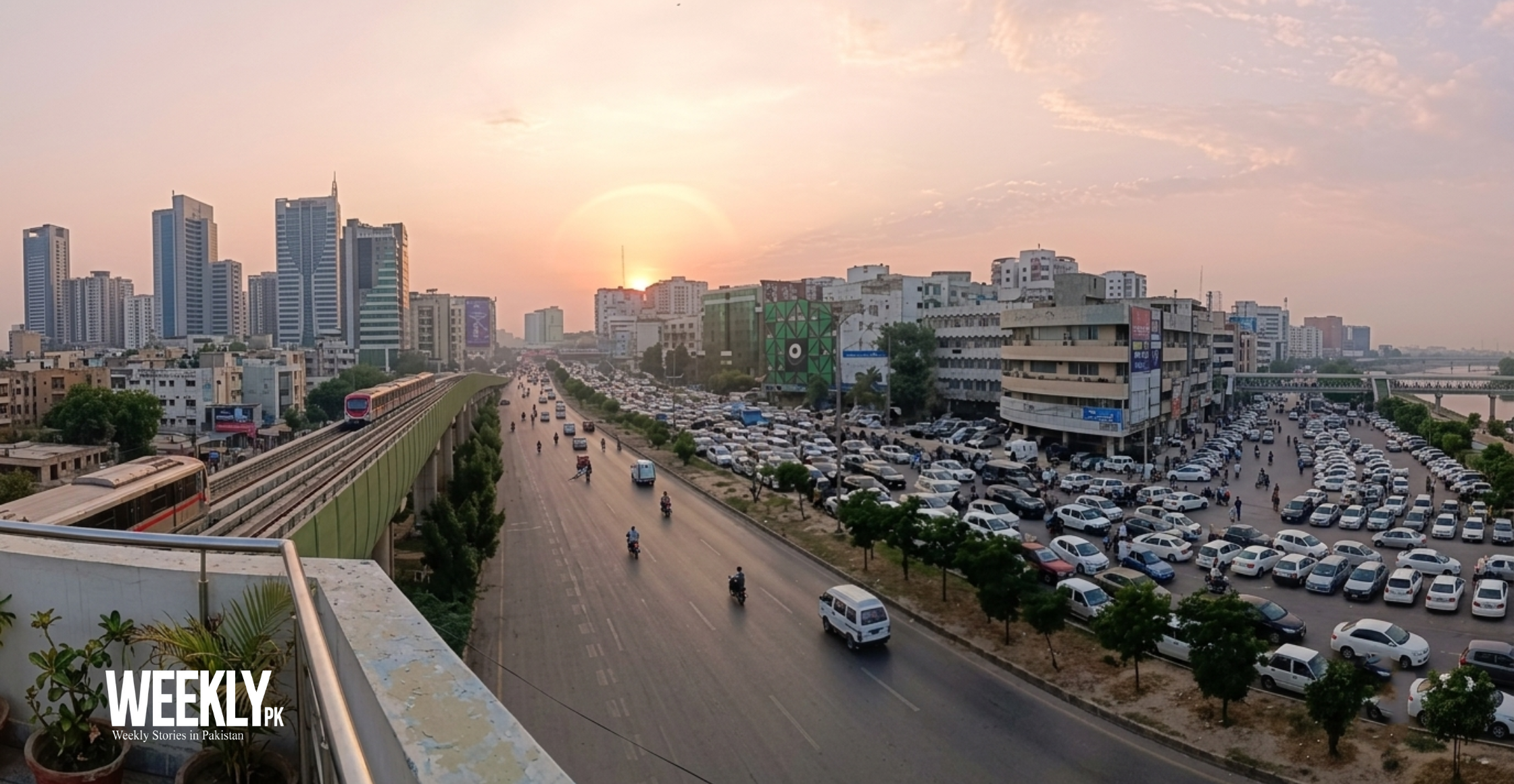
Dharna at Shahrah-e-Faisal Jamaat-e-Islami Blocks Road. Jamaat-e-Islami Karachi Chief Monem Zafar announced that Jamaat-e-Islami will hold nationwide protests today against the petroleum levy charges, calling for public participation across the country, with Karachi’s own demonstration centred on Shahrah-e-Faisal, one of the city’s busiest arteries. Party workers are expected to block traffic along the road as part of the countrywide sit-in drive scheduled to begin at 4pm, making Karachi one of the most closely watched fronts in Friday’s nationwide campaign.
The choice of Shahrah-e-Faisal as the city’s main protest site is unlikely to be incidental. The road connects Jinnah International Airport to the city’s central business districts and several of its most densely populated residential areas, meaning a sustained blockade there carries the potential to disrupt movement across a much wider stretch of Karachi than a protest confined to a smaller road or a government office frontage would. Zafar’s announcement effectively positions Karachi’s business and commuter corridor as the local face of a protest campaign that JI leadership has been building toward for weeks.
That national campaign was laid out in full on Thursday by JI Emir Hafiz Naeemur Rehman, whose remarks in Lahore set the tone and demands that Karachi’s demonstration will echo on Friday. Addressing a protest rally by the JI Women’s Wing on Wahdat Road against rising petroleum prices and inflation, Rehman announced that peaceful sit-ins against the petroleum levy would be held at 510 locations across the country, warning that the protests would transform into a movement to overthrow the government if authorities attempted to stop them. He said major roads linking districts across Pakistan, Shahrah-e-Faisal among them, would be blocked from 4pm onwards, though ambulances would be allowed to pass without interruption.
“If obstacles are created or our peaceful protest against the petroleum levy is blocked, this campaign will turn into an anti-government movement,” he said, demanding that the price of petrol be reduced to Rs225 per litre, the same figure JI’s Karachi leadership has repeated at local rallies ahead of Friday’s sit-in.
Rehman described the petroleum levy as “extortion” rather than a tax, claiming that the government was collecting Rs125 in taxes on every litre of petrol from ordinary citizens while continuing lavish spending on luxury aircraft and expensive official vehicles. “Enough is enough,” he said. He argued that petroleum prices had been increased by citing global market conditions during regional conflicts but were not reduced after international crude oil prices fell to $74 per barrel, and alleged that the government had collected roughly Rs8 trillion through the levy without investing any of it in upgrading oil refineries or petroleum infrastructure. “The economy can recover if the government abolishes the petroleum levy,” he asserted.
He also said the ruling coalition was disconnected from the hardships faced by ordinary Pakistanis, adding that women were struggling to manage household kitchens due to soaring inflation and, in many cases, were being forced to sell their jewellery to support their families, while criticising unequal access to education, an unresponsive bureaucracy and restrictions on public dissent as evidence of a dysfunctional governance system. He accused the government of having become subservient to the International Monetary Fund, imposing taxes and approving what he called an anti-people budget while ignoring recommendations to reduce state expenditure.
Reiterating that Friday’s demonstrations would remain peaceful, Rehman called on people from Punjab, Sindh, Balochistan, Khyber Pakhtunkhwa and Azad Jammu and Kashmir to participate in large numbers, specifically urging young people to bring their motorcycles onto the roads and join the sit-ins.
That national call has translated into weeks of preparatory activity in Karachi specifically. Ahead of Friday’s main event, JI’s Karachi chapter organised a women’s march at Shahrah-e-Quaideen focused on the impact of inflation on household budgets, alongside youth-led motorcycle rallies intended to build turnout for the sit-ins among younger supporters, mirroring the appeal Rehman made in Lahore. Zafar’s press conference framed Friday’s demonstration as the culmination of that local groundwork rather than a one-off action tied purely to the nationwide announcement, positioning Karachi as a deliberately built-up front in the broader campaign rather than simply one of 510 locations observing the same call.
Karachi’s relationship with JI-led street protests carries a recent history of friction with the provincial administration that is likely to inform how Friday’s demonstration unfolds. In February, police used teargas and baton charges to disperse JI workers attempting to march toward the Sindh Assembly as part of the party’s separate “Jeenay Do Karachi Ko” campaign over the city’s civic infrastructure, a confrontation JI leaders at the time described as evidence of heavy-handed treatment by the Sindh government. Whether Friday’s larger, petroleum levy-focused sit-in on Shahrah-e-Faisal draws a similar response from local authorities, or is permitted to proceed with fewer obstructions, is likely to shape how the demonstration is remembered in the city regardless of its size.
The underlying economic grievance behind Friday’s protest has particular resonance in Karachi given the city’s role as the country’s largest commercial and logistics hub. JI leadership has repeatedly pointed to the gap between falling international crude oil prices and the domestic retail price of petrol as evidence that the levy, rather than genuine market conditions, is now the primary driver of what motorists pay at the pump, a claim that carries added weight for Karachi’s trader and transport communities, who are directly exposed to fuel-driven increases in freight charges and the cost of doing business. Zafar’s mobilisation efforts in the city have leaned heavily on appeals to exactly these groups, consistent with the broader campaign’s strategy of building turnout around constituencies most immediately affected by fuel costs.
With the 4pm start time for the sit-ins approaching, commuters and businesses along Shahrah-e-Faisal and other affected routes across Karachi are expected to face significant disruption for the duration of the protest. Organisers in Karachi have said, as they have nationwide, that emergency vehicles will be permitted through the blockade despite the road closures. How long the closures persist, and whether Friday’s demonstration remains as peaceful as both Zafar and Rehman have promised, will likely determine whether the campaign builds toward the broader anti-government movement Rehman warned of in Lahore, or settles, as similar JI-led protests have in the past, into another round of pressure followed eventually by negotiation with the federal government.
Compiled by the Weekly PK Staff Desk.
Leave a Reply