
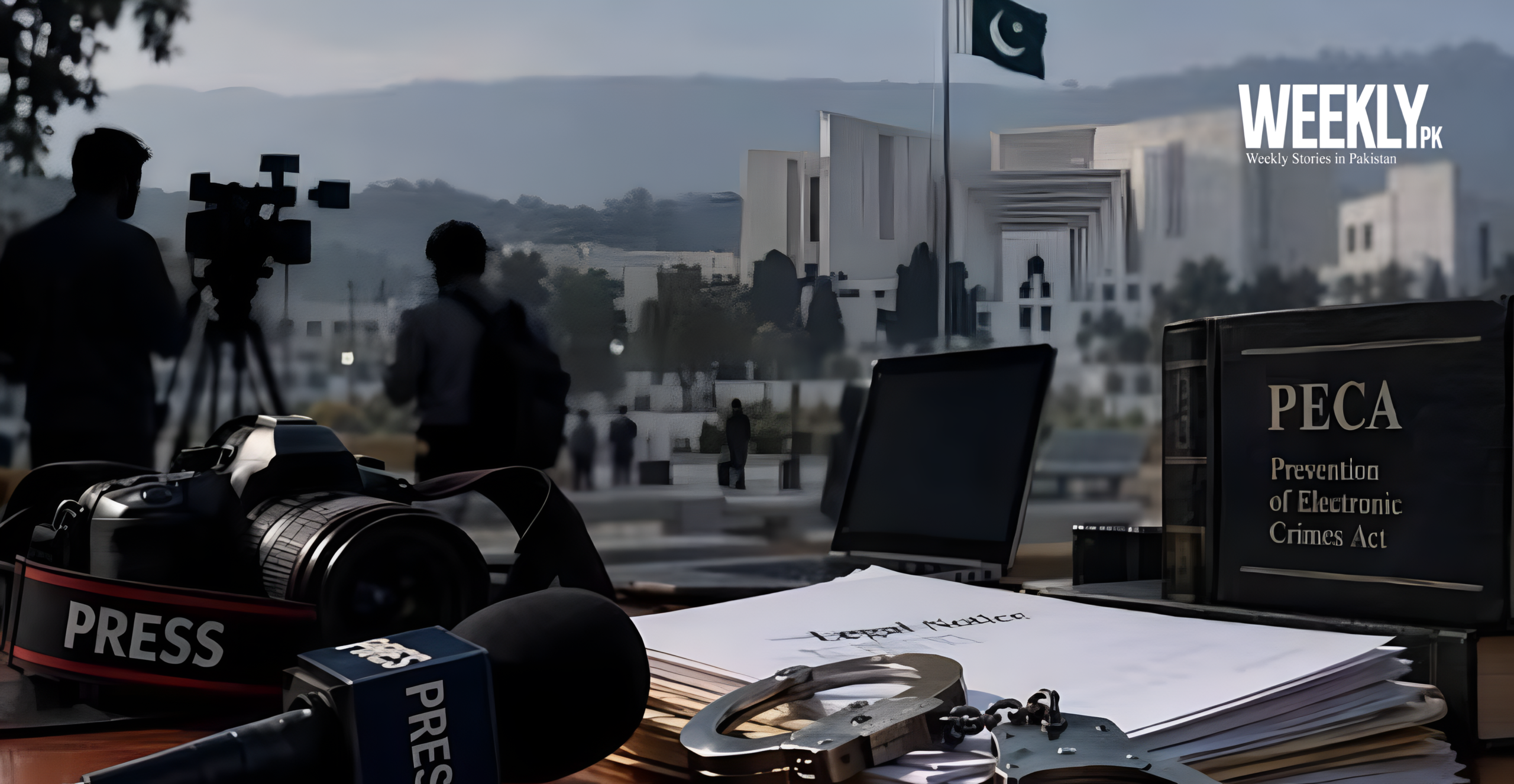
Legal harassment has become a leading threat to journalists in Pakistan, with cybercrime investigations, repeated summonses and prolonged court proceedings increasingly used to pressure media workers even when no conviction follows, according to Freedom Network’s annual Impunity Report 2026. The report, titled “From Violence to Lawfare: Process as Punishment for Journalists,” was released on Thursday ahead of the International Day to End Impunity for Crimes against Journalists on November 2.
The report was prepared with technical support from International Media Support and written by journalist Adnan Rehmat and Freedom Network Executive Director Iqbal Khattak. It covers the period from October 2025 to August 2026 and documents a shift from physical intimidation to legal and administrative procedures as a method of suppressing critical reporting. Its central argument is that the process itself functions as punishment: a journalist who is summoned repeatedly, required to appear in multiple courts or investigated under the cybercrime law faces costs in time, money and reputation whether or not the case ends in a conviction.
According to Dawn’s account of the report, Freedom Network recorded 78 violations against media workers over the 11-month period. These included one killing linked to professional activity, three attempted killings, 18 threats of killing or harm, 11 attacks, 13 legal actions and 32 threats of legal action. Other outlets have cited a higher total of 97 violations for the same period, a discrepancy that may reflect differences in how categories were counted, and readers should refer to the report itself for the definitive figure. The watchdog stressed that a decline in recorded cases does not mean greater safety for journalists, a point it has made in previous years as well.
The report identifies the Prevention of Electronic Crimes Act (Peca) as the central instrument of legal pressure on online journalism. It says the National Cyber Crime Investigation Agency (NCCIA) is increasingly using the law against journalists and digital media practitioners to punish dissent, and that the pattern frequently emerges in cases involving reporting on public expenditure, official misconduct or corruption. The legal process, the report argues, becomes a form of harassment through its length and unpredictability.
Freedom Network also questioned the effectiveness of the institutions created under Pakistan’s two journalist protection laws. Although the country has enacted specific legislation at the federal and provincial levels, Khattak said the statutory protection mechanisms were not working as intended, with federal safety commissions largely non-functional due to administrative inaction. The organisation said more than 170 journalists have been killed in the line of duty in Pakistan since January 2000, while perpetrators were punished in only three of those killings, figures that illustrate the scale of impunity for physical violence even as the pattern of threats evolves.
The report’s findings echo the group’s monthly monitoring. In its September report, released on October 10, Freedom Network said legal actions and cybercrime probes made up three of the five cases it documented that month, and that four of the five involved state actors, in cases across Islamabad, Rawalpindi, Chakwal and Multan. It said it had found no evidence of wrongdoing by the journalists in the material it reviewed, and cautioned that the five cases were not a comprehensive count of every threat journalists face.
Also Read: Multan Teen’s Alleged Killer Tauqeer Nazir Escapes Custody, Dies in CCD Encounter in Bahawalpur
The findings arrive as cybercrime cases have drawn attention. This month, journalist and political leader Iqrar ul Hassan was remanded to NCCIA custody for four days over allegations of sharing anti-state, false and defamatory material through his social media accounts. The agency’s allegations have not been tested in court, and the case involves a person who is also a political figure, which means it does not fit neatly into any one category. It nonetheless shows how the agency’s powers over online content have become a subject of public debate. In an earlier report on that case, we noted that supporters of the law argue online disinformation and defamation cause real harm, while press freedom advocates say provisions on false or defamatory material can be applied in ways that chill criticism. The government and the NCCIA have not yet publicly responded to the Freedom Network report in the coverage reviewed.
What the report does highlight is the weakness of the safeguards. A journalist facing a Peca case has limited options for quick redress, and the existence of protection commissions on paper does little if they cannot function. Freedom Network’s recommendations, as summarised in coverage, centre on activating those mechanisms and preventing the legal system from becoming a tool of oppression. The organisation argues that protecting press freedom is essential to democratic governance.
Several questions follow. How many of the cases tracked in the report have led to convictions, and how many have simply continued without resolution? Will the federal safety commissions be made operational, and with what powers? And will the government engage with the report’s criticisms, or treat them as an advocacy document? The answers will shape whether the label of “lawfare” sticks or is challenged with evidence on the other side.
For journalists, the difference between violence and lawfare is partly one of visibility. A physical attack draws immediate condemnation, while a summons or a court date may pass unnoticed. As the International Day to End Impunity approaches, the report is a reminder that the absence of headline-grabbing attacks does not mean that reporting has become safer, only that the pressure has found a quieter form.
Compiled by the Weekly PK Media Desk.
Leave a Reply