
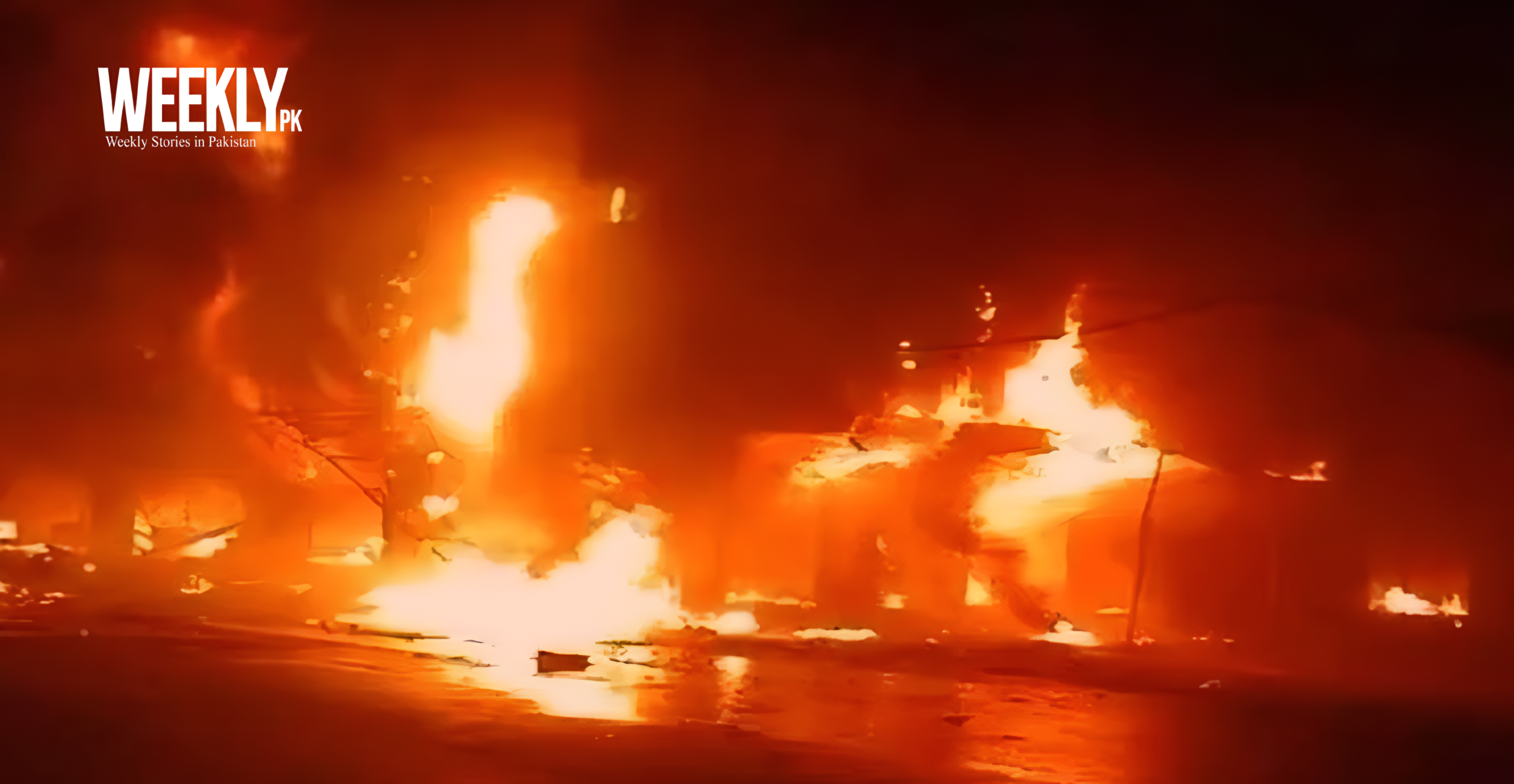
A fire tore through a furniture market near Kamran Chowrangi in Karachi’s Gulistan-e-Johar on Friday, spreading to a nearby residential building before firefighters brought it under control. No casualties were reported, but shopkeepers say they suffered losses worth crores of rupees, and they have raised questions about how long it took fire tenders to reach the scene. For a market that burned less than two years ago, the incident has revived familiar concerns about fire safety and emergency response in the city.
Chief Fire Officer Humayun Khan said four fire tenders and a water bowser were used in the operation, and that the main blaze had been brought under control, with cooling operations continuing to prevent it from reigniting. The flames also reached an adjoining residential building, which Rescue 1122 said was brought under control as well. Khan confirmed that there had been no loss of life. The cause of the fire and the extent of the financial damage have not been officially established, and reports so far have not said how badly the residential building was affected or whether any residents had to leave their homes.
A shopkeeper named Asghar told reporters that the market had around 20 shops and that the fire had caused losses worth crores of rupees. He said the fire was reported to the Karachi police’s Madadgar-15 helpline, but firefighters took 15 to 20 minutes to arrive, by which time the flames had spread through the market. Those figures are the traders’ account, and officials have not publicly commented on the response time. ARY News, which also reported the incident, noted the same delay and said the Chief Fire Officer described the market as having experienced a fire before.
The market has indeed been here before. Asghar said it had caught fire last year, and Geo News reported that the same market suffered a major fire on December 31, 2024, in which more than 30 shops were gutted. ARY described that blaze as causing extensive damage, with furniture worth millions reduced to ashes. Officials said at the time that the cause had not been determined, and no casualties were reported then either. Asghar also said the shops had been set up on a commercial plot, a detail that may become relevant if authorities examine how the market was built and whether it met safety requirements.
The incident comes at a time when fire safety in Karachi is under unusual scrutiny. Following the deadly Gul Plaza inferno in January this year, Sindh Chief Minister Syed Murad Ali Shah ordered a province-wide fire safety audit of major government, private and commercial buildings. He also approved resuming annual safety inspections of commercial buildings, which had been discontinued years earlier. A subsequent audit by the Sindh Building Control Authority (SBCA) found that 90% of the buildings surveyed in the city’s eastern, central and southern districts lacked fire-safety arrangements. The authority issued notices to more than 300 building owners, warning that their buildings could be sealed if required fire safety measures were not installed, and in February the district administration sealed two major commercial buildings in Saddar for breaching fire safety regulations.
Those measures were aimed largely at buildings such as plazas and malls, where fires can trap large numbers of people. A furniture market presents a different kind of risk. Stocks of wood, foam, fabric and varnish can burn quickly, and rows of closely packed shops allow fire to spread from one to another within minutes, which is why the first quarter of an hour often decides whether a blaze stays contained or becomes a total loss. That makes the speed of the response especially important, and it is why the traders’ claim about the delay will need an answer. Karachi’s fire services have often been criticised for limited resources and for congested roads that slow fire tenders, and while no such explanation has been offered in this case, the question of how quickly help arrives is likely to be raised again.
Also Read: Islamabad Shuts H-9 and G-6 Weekly Bazaars Over Fire Safety After Eight Fires Since 2017
It is not the first time Gulistan-e-Johar has seen fires with concerns about response. Last November, a fire in huts near Munnawar Chowrangi in the same locality burned through hundreds of shelters, with 24NewsHD reporting that around 300 of 500 huts were destroyed and a resident saying only two or three fire brigade vehicles reached the site. That incident involved a different kind of settlement and a different location, so it should not be treated as the same problem, but it points to a pattern in which fires in this part of the city have spread widely before they were brought under control.
Karachi is not alone. In Islamabad earlier this month, authorities closed the H-9 and G-6 weekly bazaars until they obtained fire safety clearance, after the interior minister told the Senate that the H-9 market had suffered eight fires since 2017, causing losses of around Rs60 crore, with no compensation paid to affected stallholders. The two cities differ in many ways, but the common thread is markets with dense stalls and combustible goods, repeated fires, and a gap between the safety plans that follow each incident and the safeguards that exist on the ground.
Several questions follow from Friday’s fire. What caused it, and was it the same hazard that was suspected in 2024, when the cause was never publicly determined? Was the market covered by any of the inspections carried out after the Gul Plaza fire, and did it have functioning fire-safety equipment? What exactly was the response time, and was anything delaying the fire tenders? What is the legal status of a market built on a commercial plot, and who was responsible for approving and monitoring it? And what, if anything, is being done to support traders who have now lost their shops twice in two years?
For the shopkeepers, those questions are not abstract. A market that has burned twice in less than two years is a business that cannot easily recover a third time, and traders are likely to want clear answers on the cause and on whether the site can be made safe. The authorities, for their part, will face pressure to show that the audits and inspections ordered earlier this year are reaching places like this one, not just the high-profile buildings that make headlines after a deadly fire. Until a cause is announced and the response is explained, Friday’s blaze will stand as another reminder that Karachi’s fire safety measures are still catching up with the risks they are meant to address.
Compiled by the Weekly PK City Desk.
Leave a Reply