
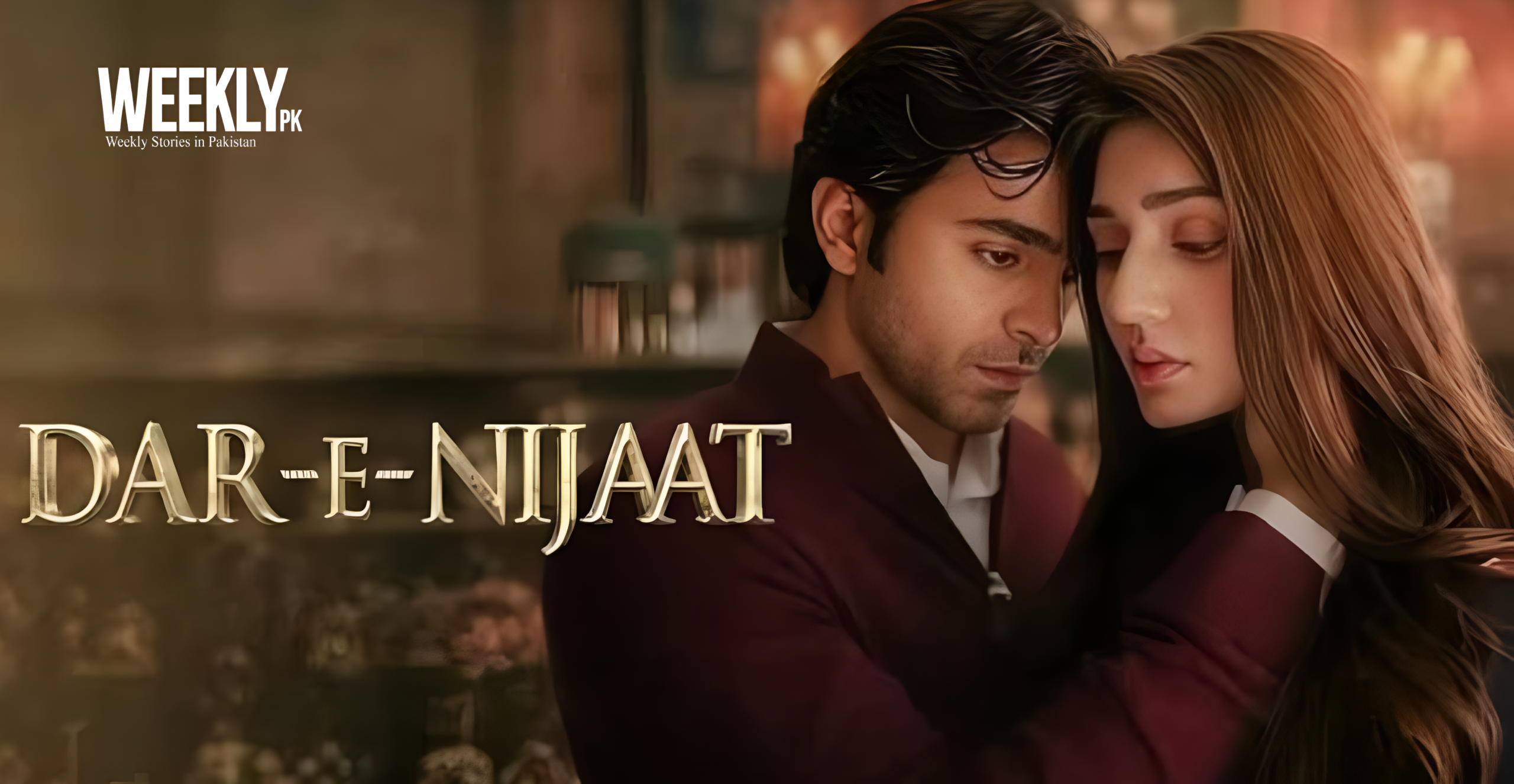
For most of its run, Dar-e-Nijaat has let Abu Bakar exist as a kind of narrative safe harbour. While Zamil spirals through hypocrisy and Zaryab absorbs one betrayal after another, Abu Bakar has simply stood still, calm, unbothered, endlessly patient. He doesn’t raise his voice. He doesn’t judge her past. He shows up. For an audience exhausted by Zamil’s contradictions, that stillness has read as strength. But recent episodes have started chipping away at the idea that Abu Bakar’s past is as clean as his demeanor suggests, and what’s emerging instead is a much messier picture than anyone expected.
The shift didn’t happen all at once. It’s been building quietly since a teaser dropped weeks ago showing a woman arriving at Abu Bakar’s home and, when questioned, simply identifying herself as his wife. At the time, it played almost like a red herring, the kind of fake-out dramas use to manufacture a few days of speculation before moving on. Except Dar-e-Nijaat hasn’t moved on. If anything, the show has spent more time reinforcing that thread than dismissing it, and that alone should tell longtime drama viewers something. A story this deliberate about not clearing up a rumor is usually a story building toward confirming it.
What makes the complication land harder is who’s protecting it. This isn’t a stranger’s secret. It’s Abu Bakar’s own mother, Khushbakht, sitting on information that could unravel the entire image Zaryab has built of him. In a recent exchange with Kishwar Jahan, a family friend who appears to know exactly what’s being hidden, Khushbakht doesn’t deny that something is being kept quiet. She defends it. When Kishwar Jahan pushes back, telling her plainly that she can’t let Zaryab walk into this marriage without knowing the truth, Khushbakht’s response is telling in itself: she reminds Kishwar Jahan that she once kept a similar secret buried for years, on her behalf. That’s not the exchange of two women debating a misunderstanding. That’s two women who both know precisely what’s at stake and have simply disagreed, for years now, on whether it should ever come out.
That single scene reframes almost everything the show has built around Abu Bakar so far. His piety, his patience, his refusal to judge Zaryab for her past, all of it has been presented to the audience through Zaryab’s eyes, and Zaryab is, understandably, not an objective narrator right now. She’s coming off Zamil’s public rejection, she’s exhausted from constantly defending herself, and Abu Bakar represents the first person in months who hasn’t made her feel like a problem to be managed. Of course she reads him as uncomplicated. She needs him to be. But needing someone to be simple and that person actually being simple are two very different things, and Dar-e-Nijaat seems increasingly interested in the gap between the two.
It’s worth revisiting how the marriage conversation between Zaryab and Abu Bakar actually played out, because it’s easy to miss how one-sided it was. When they finally sit down to discuss the idea seriously, Abu Bakar doesn’t ask her anything. He doesn’t bring up what Zamil said about her past, doesn’t ask how she’s processing any of it, doesn’t probe into what she actually wants from a marriage after everything she’s been through. He simply states his own terms, that he can’t offer her the lifestyle she’s used to, and waits to see if she’ll accept those terms as they are. She does. But notice what’s missing from that entire scene: nothing from Abu Bakar about himself. No history, no context, no explanation of who he’s been before this moment. For a man being positioned as the emotionally honest alternative to Zamil, he’s remarkably closed off about his own life. At the time, that read as humility. In light of the mystery wife and his mother’s guarded exchange with Kishwar Jahan, it reads more like omission.
There’s also the matter of Zaryab’s own motivation, which the show has been surprisingly upfront about even while keeping Abu Bakar himself opaque. Her internal reasoning for accepting his proposal isn’t really about him at all. It’s about Zamil, about proving that a genuinely religious, principled man would choose her despite everything Zamil judged her for. That’s a marriage being entered for the sake of a point being made to someone else entirely, and it means Zaryab isn’t necessarily marrying Abu Bakar the person. She’s marrying Abu Bakar the symbol, the idea of vindication he happens to represent. If it turns out that symbol is hiding a wife, or a past marriage, or whatever truth Khushbakht and Kishwar Jahan are circling around without naming, Zaryab isn’t just facing a plot twist. She’s facing the possibility that she walked into another version of the exact trap she just escaped, choosing a man for what he represents rather than who he actually is.
To be fair to the writing, Dar-e-Nijaat hasn’t slammed the door on a simpler explanation. It’s entirely possible the mystery woman turns out to be a cousin, or a case of mistaken identity, or a rumor Kishwar Jahan is overreacting to. Umera Ahmed’s scripts have a history of planting red herrings specifically to test how quickly audiences jump to the darkest conclusion, and there’s a version of this story where Abu Bakar comes out the other side exactly as uncomplicated as Zaryab believes him to be. But the amount of narrative real estate the show has dedicated to this thread, an entire teaser, a recurring subplot around Kishwar Jahan, a pointed exchange between two older women who clearly know more than they’re saying, suggests the writers aren’t building toward nothing. Shows don’t usually spend this much time protecting a secret that turns out to be harmless.
What’s clear right now, fifteen-plus episodes in, is that Abu Bakar can no longer be read as the simple, safe option he was introduced as. Whatever’s being hidden by Khushbakht, whoever that woman at his door actually is, the show has made sure the audience can’t fully trust the picture Zaryab has painted of him. And that puts viewers in an uncomfortable position alongside her: rooting for a resolution, while quietly bracing for the possibility that Zaryab’s next chapter isn’t a rescue at all, just a different, better-disguised version of the same mistake.
Compiled by the Weekly PK Entertainment Desk
Leave a Reply