
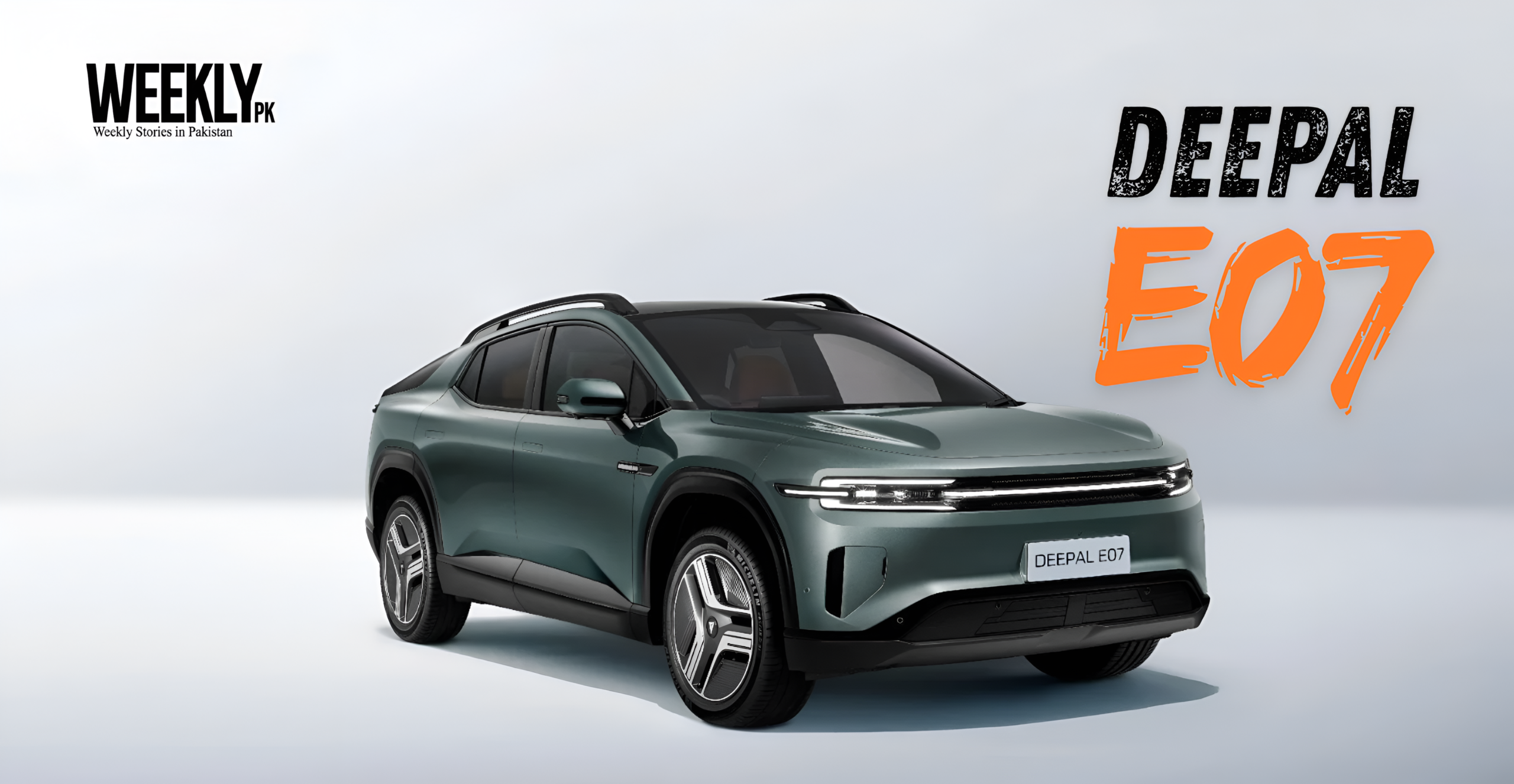
Master Changan Motors Limited began handing over its Deepal E07 electric “Multitruck” to Pakistani customers this week, nine months after the vehicle was first unveiled at the Pakistan Auto Show in November 2025 at an ex-factory price of Rs19 million. The delivery milestone, arriving with a Rs4 million booking fee structure that has remained unchanged since bookings opened, offers a useful window into where serious capital is currently being committed in Pakistan’s automotive sector, and it is not, by any measure, toward the mass market.
The E07 itself is a genuine engineering showcase. Built on Changan’s newer digitalised platform in partnership with Huawei and CATL, the vehicle produces 590 horsepower from a dual-motor all-wheel-drive setup, accelerates from zero to 100 kilometres per hour in 3.9 seconds, and offers a claimed range of 590 kilometres on an 89.9 kWh battery with fast-charging capability from 30 to 80 percent in roughly 15 minutes. Its defining feature, a rear section that converts from an enclosed SUV cabin into an open pickup bed with a 1,500 kilogram towing capacity, has been marketed by the company as the world’s first “Multitruck,” a category Deepal is positioning as an entirely new segment for the Pakistani market rather than a direct competitor to existing SUVs or pickups.
None of that changes the basic arithmetic facing most Pakistani car buyers. At Rs19 million ex-factory, before registration, taxes and on-road costs that typically push such figures well past Rs20 million, the E07 sits roughly in the price bracket of a small residential plot in several major cities. One commenter on ProPakistani’s coverage of the launch pointedly compared it to what it once cost to establish an entire automotive manufacturing plant in Karachi. That comparison is exaggerated, but the underlying point about scale is not: this is a vehicle priced for a buyer pool measured in the low thousands nationwide, not the mass consumer base that drives volume in Pakistan’s auto sector.
That positioning is deliberate, and it reflects a broader pattern in how new energy vehicle investment has entered Pakistan so far. Rather than competing on price against Pakistan’s dominant hybrid and compact SUV segment, where Toyota, Suzuki and Kia continue to hold the bulk of volume sales, Master Changan’s NEV push under the Deepal brand has concentrated almost entirely at the premium end, with the E07 joining the previously launched S05 and other Deepal models pitched at what the company itself has described as an affluent, tech-forward buyer segment. Company leadership has framed this as a long-term strategy, with chief executive Danial Malik describing plans for three brands and eleven new vehicles over the next two years, but the near-term revenue and import composition of that strategy skews heavily toward vehicles most Pakistani households will never realistically consider.
The forex dimension is worth sitting with as well. A premium electric vehicle at this price point carries a substantial import content, in battery cells, semiconductors, and specialised components not yet locally manufactured, even under CKD assembly arrangements that reduce the tariff burden relative to fully imported vehicles. Each unit sold represents real dollar outflow at a moment when the State Bank has spent the better part of two years rebuilding foreign exchange reserves under the current IMF programme, a tension that sits awkwardly next to the government’s own stated ambition to position Pakistan as a serious destination for new energy vehicle investment and reduce long-term dependence on imported fuel.
There is a case to be made that premium EV launches like the E07 serve a demonstration function that matters beyond their immediate sales volume. They signal to global manufacturers and to domestic policymakers that Pakistan’s market can support serious electric vehicle investment, they build supply chain familiarity, and they help create the initial charging and service infrastructure that lower-priced models will eventually depend on. Master Changan’s own roadmap, which includes a forthcoming range-extended electric pickup and a compact SUV under its Changan brand, suggests the company is treating the E07 as an opening move in a broader segment strategy rather than a standalone product, one intended to build brand credibility at the top of the market before pushing down toward higher-volume price points.
But the timing of a Rs19 million vehicle delivery is difficult to separate from the wider economic backdrop it arrived against. The same week Master Changan began deliveries, the government was negotiating a Rs32 per litre diesel price cut with refineries specifically to ease pressure on farmers and transport operators, while Jamaat-e-Islami’s sit-ins over the petroleum levy continued outside Governor Houses in four provincial capitals, with party leadership demanding petrol be fixed at Rs225 per litre against a backdrop of a Rs114 per litre tax load. That contrast illustrates a familiar divergence in how different parts of Pakistan’s economy are experiencing this moment. One segment of consumer demand is negotiating over a few rupees per litre of diesel and organising nationwide protests over fuel affordability. Another is placing four-million-rupee deposits on a vehicle whose starting price alone could cover several years of an average household’s total fuel spending, with buyers evidently unbothered enough by pricing to keep bookings flowing since November without any discount or incentive attached.
Both realities are genuine and simultaneous features of the same economy, and neither cancels the other out. Premium EV investment can coexist with a fuel affordability crisis without either being illegitimate, since they draw on entirely different pools of capital and serve entirely different consumer bases. But the gap between them, a household negotiating whether it can absorb a few rupees more per litre at the pump, and a buyer segment absorbing a Rs4 million booking deposit without apparent hesitation, is, if anything, the more telling economic story here than the vehicle’s specifications ever could be, a reminder of how unevenly investment, and the confidence that drives it, is currently distributed across the country.
Compiled by the Weekly PK Business Desk.
Leave a Reply