
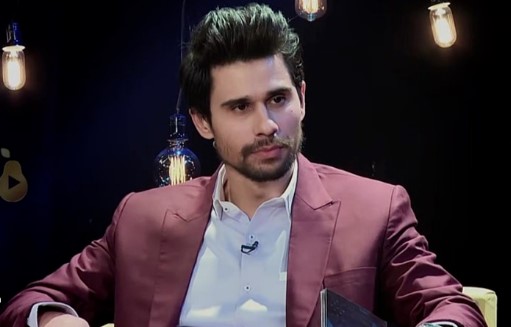
To understand why the last week has been such a bad one for Tabish Hashmi’s credibility, it helps to understand why anyone believed him in the first place. He is not a career broadcaster who drifted into hosting because a network needed a face. He built an audience from nothing, on the strength of being the one guy on Pakistani television who seemed to be saying what everyone else in the room was too polite to say. That reputation is the entire asset that got spent this week, and it is worth walking through how he earned it before getting into how he burned some of it.
From corporate marketing to comedy’s most unlikely breakout
Hashmi’s path into entertainment did not run through a drama school or a media dynasty. Born in Karachi in the mid-1980s, he spent a chunk of his early career in the corporate world, working in marketing and brand management before a stretch based out of Canada, where by several accounts he worked in logistics while continuing to perform stand-up on the side. That corporate background matters for understanding his later persona, because when he eventually made the jump to full-time comedy, he brought with him a kind of professional fluency, sharp, quick, comfortable improvising in front of an audience, that stood out against a Pakistani entertainment landscape still dominated by drama actors and traditional television hosts.
His actual breakout came through the internet rather than a television studio. Hashmi rose to prominence through Nashpati Prime’s digital talk show To Be Honest, a low-budget, high-wit celebrity interview format that traded the stiffness of mainstream Pakistani chat shows for something closer to an unscripted podcast, blunt questions, visible skepticism, guests occasionally squirming rather than being softballed. It made him an internet sensation in a way that older, more established hosts had not managed, precisely because it did not look or feel like Pakistani television as audiences knew it. That digital-native credibility, the sense that he had built an audience organically rather than being handed one, became the foundation of everything that came after.
In 2021, Geo TV brought him onto national television as host of Hasna Mana Hai, a comedy talk show that combined celebrity roasting, sketch comedy and the same conversational bluntness that had worked for him online. It became, by most industry accounts, one of the most-watched entertainment programs in the country, racking up billions of digital views and turning Hashmi into a genuine household name, no longer just a digital comedian with a cult following but a mainstream figure recognised well beyond the demographic that had discovered him through YouTube. He expanded from there, taking on hosting duties for Pakistan Got Talent and even stepping into film with a role in Aag Lagay Basti Mein alongside Fahad Mustafa and Mahira Khan. By any reasonable measure, he had completed the rare transition from internet comedian to mainstream entertainment institution.
The bluntness that built him also got him in trouble
The same instinct that made Hashmi compelling, saying the thing everyone else in the room wouldn’t, was never going to stay contained to celebrity roasting forever, and it periodically got him into genuine trouble. The most cited example predates this year’s Kashmir controversy by more than two years. During a live PSL broadcast in February 2024, co-host Mariyam Nafees was asked which team she supported and, after naming a few others, added that she liked Karachi’s team least because of its performance. Hashmi’s on-air response, an innuendo-laced remark about her husband also being from Karachi, landed badly with a live audience and worse online, and he later addressed the backlash directly on a podcast appearance, acknowledging the joke as a private exchange between the two of them that had not translated well to a public broadcast. It was a minor scandal by television standards, but it established a pattern that would recur, Hashmi’s unscripted instincts sometimes producing genuinely sharp television and sometimes producing something that needed walking back days later.
That same bluntness also produced some of his most respected moments. His interview with Karachi mayor Murtaza Wahab became widely discussed precisely because Hashmi refused to let the conversation stay in the safe, ceremonial register mayoral interviews usually occupy, pressing on broken roads, water shortages and the basic infrastructure failures ordinary Karachiites live with daily, the same chronic infrastructure gaps Weekly PK has reported on, using his comic timing to ask the kind of question a more deferential host would have softened. It is the interview most frequently cited by his defenders as evidence that Hashmi’s persona was never just shtick, that there was a real willingness underneath the comedy to hold power accountable, even mildly, even within the constraints of a variety show format. That reputation, comedian willing to say the uncomfortable thing to the person in charge, is precisely what made this month’s Kashmir episode initially so believable.
How the believable story became the discrediting one
The sequence is worth restating cleanly, because the order of events is the entire scandal. Hashmi posted a video expressing grief over the mounting violence in the ongoing crisis in Azad Kashmir, where the death toll from the unrest and crackdown has climbed into the dozens over recent months. In the video, he was candid about his own uncertainty, admitting he did not always know which subjects were safe to discuss publicly in Pakistan, but said the images coming out of the region were too painful to stay silent about, and called for dialogue over continued confrontation. It was, on its own, a fairly restrained and carefully hedged statement, closer to an appeal for peace than a pointed political accusation.
Three days later, he posted an Instagram farewell, thanking Hasna Mana Hai’s audience and team for what he described as nearly five years on national television, without giving any reason for the departure. He did not say Geo had removed him. He also, critically, did not say anything to discourage the interpretation that immediately took hold. Within hours, sympathetic commentary was framing the two posts as cause and effect, a comedian punished for speaking about Kashmir, a small act of state or corporate pressure playing out in real time on Instagram. Public figures voiced support. Social media users wrote posts describing it as the price of speaking honestly in Pakistan. It read, to a great many people, exactly like the Murtaza Wahab interview writ larger, Hashmi taking a real risk and paying a real cost for it.
Then, on 2 August, Geo TV’s account for the show posted that Hasna Mana Hai would return with a refreshed season, Hashmi still hosting. The farewell, it turned out, had referred to the old studio set, not his job. He followed up with a post joking that the show had received a software update. What had looked like a story about censorship was, according to the overwhelming weight of subsequent reporting, a marketing beat for a relaunch, one that had been allowed to sit inside the emotional register of a genuine, ongoing Azad Kashmir crisis for several days before being clarified.
Why the order of events is the whole scandal
The backlash that followed was sharper than anything the Mariyam Nafees joke produced, and for good reason. A joke landing badly is a comedian misjudging a room. This was different in kind, not degree. Public criticism from within the entertainment industry captured the core of it: whatever the marketing team’s intent, the effect was to let a crisis with a rising civilian death toll do the emotional heavy lifting that a season trailer normally has to do on its own, and to let an audience’s genuine willingness to believe in censorship fill in a narrative that then had to be walked back once the rebrand was ready to announce.
It matters that Hashmi’s underlying comments on Kashmir were not themselves invented. The unrest is real, well documented, and still unfolding, part of the same months-long AJK crisis Weekly PK has been tracking. What is in question is not whether he has the standing to comment on it, his track record, from the Wahab interview onward, suggests he does. What is in question is the sequencing: commentary on a real, still-developing tragedy, followed by an ambiguous departure announcement that was allowed to generate four days of sympathetic, borrowed urgency before being revealed as promotional. That gap between when the truth could have been clarified and when it actually was is not a technicality. It is the difference between a comedian expressing grief about a crisis and a marketing campaign borrowing that grief’s momentum.
What this costs beyond Hashmi himself
The real cost of this episode will likely not fall hardest on Hashmi, whose show is reportedly returning with an audience larger than before the controversy started. It falls on the credibility of the exact narrative he briefly, whether by design or convenient silence, allowed to circulate: that speaking honestly about Kashmir on Pakistani television carries real professional risk. That claim happens to be true in enough documented cases, quiet removals, informal pressure on broadcasters, self-censorship that goes unreported, that it deserves to be taken seriously each time it surfaces. A high-profile instance of it turning out to be a season-two teaser makes the next genuine case, whoever it involves, measurably harder to believe on first telling. Hashmi spent five years building a reputation as the host willing to ask the uncomfortable question. This week, for the first time, that reputation got spent on something considerably smaller than the moment it was borrowed to describe.
Leave a Reply