
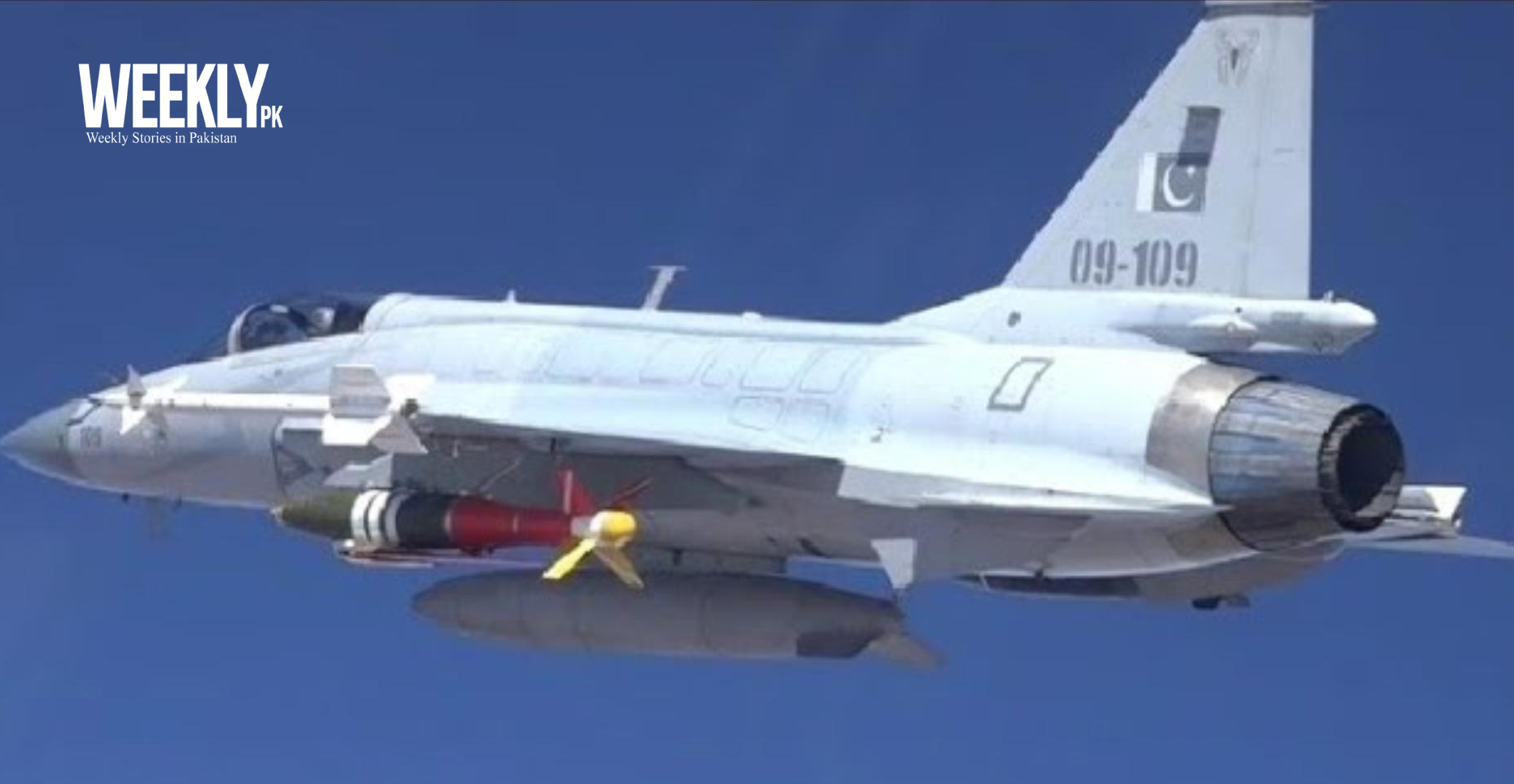
Pakistan has conducted the first flight test of its indigenously developed Fa’az air-to-air missile, the military’s media wing announced on Tuesday, describing the test as a milestone for the country’s aerospace and defence capabilities. The announcement is significant for what it signals about local weapons development, though many technical details remain undisclosed.
According to a statement from the Inter-Services Public Relations (ISPR), the missile is equipped with a state-of-the-art terminal guidance system and can engage enemy aerial targets at longer ranges. The statement said the weapon would significantly enhance the operational flexibility of the Pakistan Air Force (PAF) and strengthen the country’s overall defence posture, and that the test reflected the technical maturity, innovation and growing self-reliance of Pakistan’s defence industry. The launch was witnessed by senior officers of the armed forces, along with scientists and engineers involved in the project. The President, the Prime Minister, the Field Marshal and the services chiefs congratulated the team behind the missile, the ISPR said.
The official account is brief. The ISPR did not disclose the missile’s range, speed, launch platform or guidance type beyond the reference to a terminal guidance system. Dawn reported that defence observers believe the tested variant was the Fa’az-IIR, which is equipped with an imaging infrared seeker. Specifications attributed to the Global Industrial and Defence Solutions (GIDS) indicate that the Fa’az series has a projected range of more than 100 kilometres and a maximum speed of Mach 3.5, Dawn said. An active radar-guided variant is also reported to exist, while a longer-range Fa’az-2 is reportedly under development. Analysts cited by the newspaper said the missile was test-launched from a JF-17 fighter. These details come from observers and company specifications, not from official confirmation, and they should be treated as unverified until the military or the manufacturer releases further information.
Dawn also reported that the missile was developed under the National Engineering and Scientific Commission (NESCOM), and that mock-ups of the Fa’az-RF and Fa’az-IIR versions were first publicly shown at the International Defence Industry Fair in Istanbul in 2023. That history suggests the programme has been in development for several years, and that Tuesday’s announcement is the first public confirmation of a live flight test rather than the first sign of the project.
The significance lies in Pakistan’s current reliance on foreign weapons. According to Dawn, the PAF currently depends heavily on American and Chinese air-to-air weapons, including the AIM-120 AMRAAM, the PL-15 and other PL-series missiles. A locally developed missile could, over time, reduce dependence on foreign suppliers and give the air force greater flexibility in maintaining and upgrading its fighter fleet, the newspaper noted. Beyond supply, an indigenous weapon would allow the country to adapt it to its own aircraft and radar systems, and to modify it without needing permission from another country.
The announcement also comes at a time of intense activity in Pakistan’s defence sector. Earlier this month, on October 13, the Pakistan Army successfully test-fired an extended-range version of its Fatah-2 hypersonic ballistic missile, which the ISPR said could penetrate enemy missile defences owing to its unique trajectory and manoeuvrability. Two missile tests within three weeks suggest a deliberate effort to showcase domestic capabilities. In late October, Pakistan also signed the Badr memorandum with Qatar, Turkiye and Indonesia, an agreement covering defence industry cooperation, technology transfer, joint production and research and development, which is intended to turn the participants’ complementary strengths into joint projects. The Fa’az test falls under national development rather than that arrangement, and there is nothing in the reports to link the two directly, but they point in the same direction: a growing emphasis on building and sharing defence technology.
It is important to read the announcement for what it is. A first flight test shows that a missile can be launched and, according to the statement, perform as intended, but it is a long way from operational service. Air-to-air missiles typically go through repeated tests of range, guidance accuracy, resistance to countermeasures and integration with an aircraft’s radar and fire control systems before they can be declared ready for use. The ISPR statement said the missile’s induction into the PAF would enhance its capabilities, but it did not say when that would take place, how many missiles would be produced or what the programme costs. Those are the details that will determine whether Fa’az becomes a significant part of Pakistan’s arsenal or remains a prototype.
Several questions follow. What is the missile’s actual range and speed, and how does it compare with the imported weapons the air force uses now? Has the guidance system been tested against manoeuvring targets, and will further trials be announced? Which aircraft will carry it, apart from the JF-17 that analysts say was used in the test? And does the country’s industrial base have the capacity to produce the weapon in sufficient numbers at a reasonable cost? Without independent verification, most of those answers will have to come from the military itself or from future tests.
For now, the test marks a step in a long programme. If Fa’az reaches service as described, it would be a meaningful addition to the PAF’s weapons and a visible example of the country’s push for self-reliance in defence. Until the details are released, however, the announcement is best read as an early milestone rather than a conclusion.
Compiled by the Weekly PK Defence Desk.
Leave a Reply