
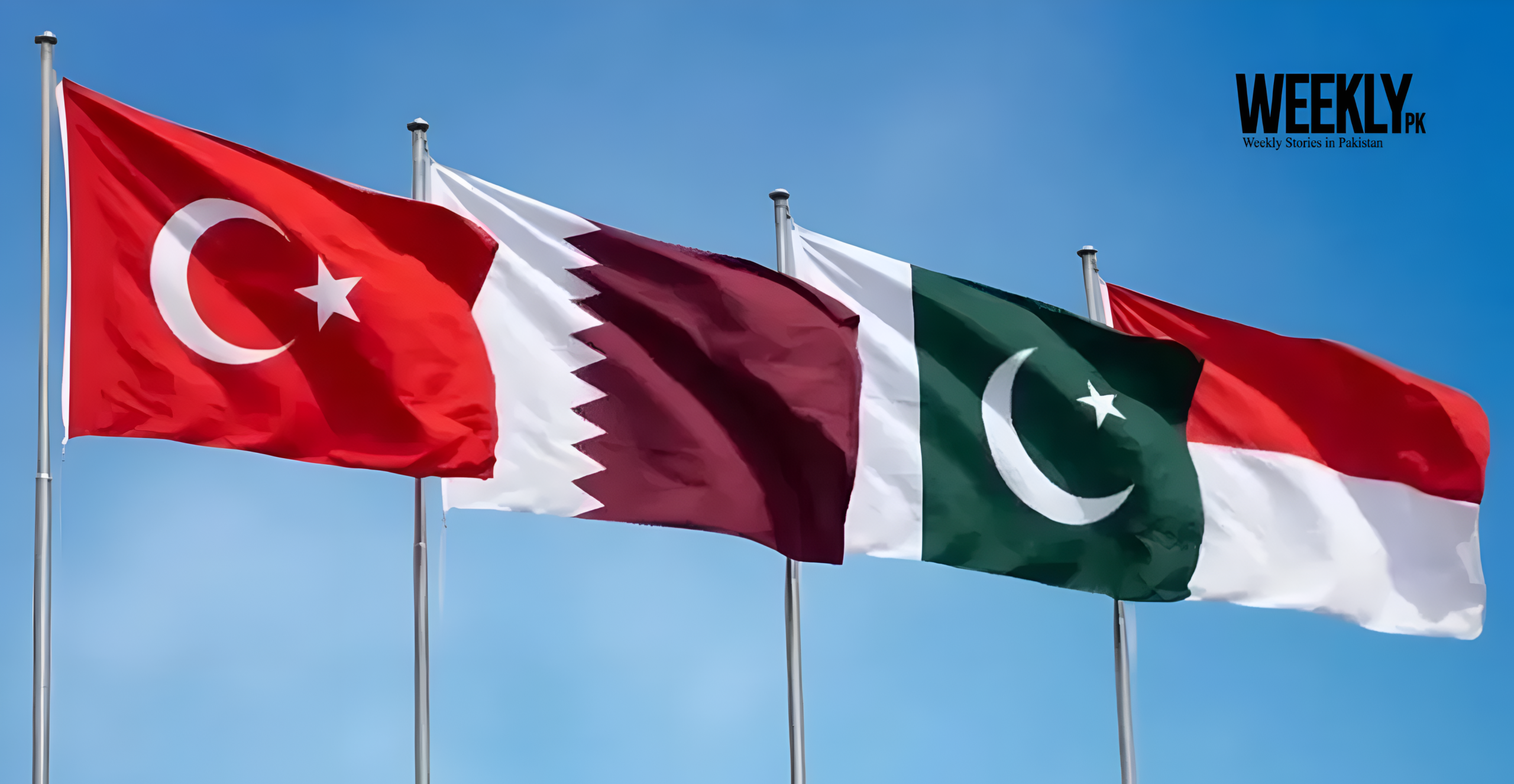
Pakistan has taken two significant steps in its defence diplomacy within the space of three days. On Wednesday, it signed the “Badr” defence cooperation memorandum with Qatar, Turkiye and Indonesia in Doha, and on Friday the Foreign Office confirmed that Pakistan and Saudi Arabia have completed ratification of the Makkah Joint Defence Agreement. The two arrangements are very different in nature, and the difference matters for understanding what Pakistan has, and has not, committed itself to.
The Badr Memorandum of Understanding was signed on October 21 by Pakistan’s Defence Minister Khawaja Muhammad Asif, Turkish Defence Minister Yasar Guler, Qatar’s Deputy Prime Minister and Minister of State for Defence Affairs Sheikh Saud bin Abdulrahman bin Hasan Al Thani, and Indonesian Deputy Defence Minister Yusuf Jauhari. According to the Turkish Defence Ministry, it reflects the four countries’ desire to deepen cooperation and develop partnerships, and it aims to turn their complementary capabilities into concrete projects. The agreement covers defence industry cooperation, technology transfer, joint production, research and development and technical training, and seeks to meet the defence requirements of the participating countries and friendly nations. It is reportedly named after the Battle of Badr in 624 AD.
The logic of the arrangement is industrial. Analyst Mevlutoglu, quoted by Al Jazeera, said Turkiye contributes technological expertise, systems integration and a mature defence industry, Pakistan and Indonesia offer manufacturing capacity, skilled workforces and sizeable domestic markets, and Qatar provides investment potential and demand. The pact builds on existing projects, including the MILGEM Babur-class corvettes that Turkiye is building with Pakistan, with production in Istanbul and Karachi, and the KAPLAN MT medium-weight tank that Turkiye is developing with Indonesia. Turkiye and Qatar already have defence industry ties, and Turkish forces are present in Qatar.
The critical point is what Badr is not. Unlike the Makkah Joint Defence Agreement, signed in August by Pakistan, Saudi Arabia and Turkiye, the Badr memorandum does not create a collective defence obligation. An attack on one participant would not oblige the others to respond. It is a framework for manufacturing and technology, not a security guarantee, and treating the two as the same would be a mistake.
The Makkah pact, by contrast, is a mutual defence treaty. Signed on August 7 in Makkah by Turkish President Recep Tayyip Erdogan, Prime Minister Shehbaz Sharif and Saudi Crown Prince Mohammed bin Salman, it provides that an armed attack on one member is an attack on all. At the Foreign Office’s weekly briefing on Friday, spokesperson Sajjad Haider Khan said Pakistan and Saudi Arabia have already completed their ratification processes, while Turkiye is undertaking the requisite procedures under its domestic legal framework. Turkiye submitted the pact to its parliament earlier this week.
Khan described the agreement as essentially defensive and consistent with Article 51 of the UN Charter, which recognises the right of self-defence. He also said there are no secret clauses in the pact, that Pakistan recognises the text that has become publicly available, and that its provisions are not directed against any third country. The statement appears to respond to public speculation about hidden provisions. On the question of whether the pact could be invoked over Houthi attacks on Saudi Arabia, he said the matter would be decided by the three partner countries in accordance with its provisions, and that the nature and extent of any assistance would be determined collectively after an objective assessment of the circumstances.
The agreement has moved towards implementation. The three countries’ Strategic Political and Defence Committee, which last met on October 5, called for the implementation of collective defence commitments and the rapid deployment of military forces and capabilities in Saudi Arabia, subject to domestic laws. Khan said matters relating to the agreement and its operationalisation remain under discussion. Earlier this week, the Director General of Inter-Services Public Relations said Pakistan was providing whatever support Saudi Arabia needs to defend itself, adding that the pact’s deterrence was already in play.
Taken together, the two developments show Pakistan building security relationships along two tracks. One is a binding mutual defence commitment with Saudi Arabia and Turkiye, now formally ratified on Pakistan’s side. The other is a broader industrial and technological network that includes Qatar and Indonesia and is designed to strengthen defence manufacturing, reduce reliance on single suppliers and open new markets. Al Jazeera described the Doha agreement as part of a wider effort by countries in the region to widen their networks of security partners amid the prolonged US-Israel war with Iran and Houthi attacks. Chinese scholars quoted by the China-Global South Project argued that Badr could reduce Pakistan’s dependence on China by giving it access to Turkish military technology, markets and joint production, a view that reflects one perspective on how the arrangement may change Pakistan’s procurement choices.
Several questions remain open. What specific projects will emerge from Badr, and how will they be financed? How will the arrangement fit with Pakistan’s existing defence cooperation, including with China, which remains its largest arms supplier? How will neighbouring countries and other partners react, particularly as the region deals with ongoing conflict? And on the Makkah pact, what exactly will “operationalisation” involve, and what role will transparency and parliamentary oversight play, given the Foreign Office’s own emphasis that there is nothing hidden in the text?
For now, the official message is one of reassurance: a defensive pact, ratified through the proper procedures, and an industrial partnership that does not commit anyone to fight. How those commitments are tested will depend on events in the Gulf over the coming weeks.
Compiled by the Weekly PK National Security Desk.
Leave a Reply